




Lost Train
and Liberation

In April 1945, the SS moved most of the hostages away from the exchange camp. The three trains that departed from Bergen-Belsen were probably headed for Theresienstadt. Many hostages died during or shortly after the journey. One of the trains was liberated near the village of Tröbitz. This train was later referred to as the “Lost Train”.
Why did the SS force the exchange hostages to leave Bergen-Belsen?
The SS still believed that the hostages held value. They wanted to exchange them for Germans in Allied captivity, or for money and goods. They did not want to hand them over to the liberators, who were rapidly approaching the camp.

© Bergen-Belsen Memorial
There are no known photos of the Lost Train. The drawings in this chapter were made by Susanne Schuller. She views the events with irony and sarcasm. The original drawings are very small, some of them quite tiny.
Susanne Schuller was also imprisoned in the Bergen-Belsen exchange camp. She did not know the Tal and Levenbach families, but was taken away from the camp on the same train.
“It’s impossible that we’re leaving! And yet it happened.” Weiter

The next day the rumours turned out to be true, and within a short time, we were supposed to report to the gate.
We started packing. We didn’t take much. Most people were too weak to carry anything, and left behind half of their already meagre possessions. That’s the way it was with us, too. My mother was too sick, and my brother was too weak to carry anything. Unfortunately, we couldn’t find his precious diary.
In the meantime, most of the camp had gathered at the gate, and all that was left to do was wait for the trucks, which finally arrived. Patients, old people and small children crammed in, and we began the long trek to the train platform.
How did the prisoners get from the exchange camp to the railway ramp?
Most prisoners had to walk the approximately six kilometres to the railway ramp. Weak, sick and elderly prisoners were transported by truck.

© Bergen-Belsen Memorial
Why did the SS bring thousands of other prisoners to Bergen-Belsen in April 1945?
In the weeks before the war ended, Bergen-Belsen became the destination of death marches and evacuation transports from other camps. To prevent the concentration camp prisoners from being liberated, the SS transported them deeper inside the German Reich.

“As we were being evacuated from the camp, thousands of new prisoners arrived in Bergen-Belsen.”

What did the exchange prisoners see on their way to the railway ramp?
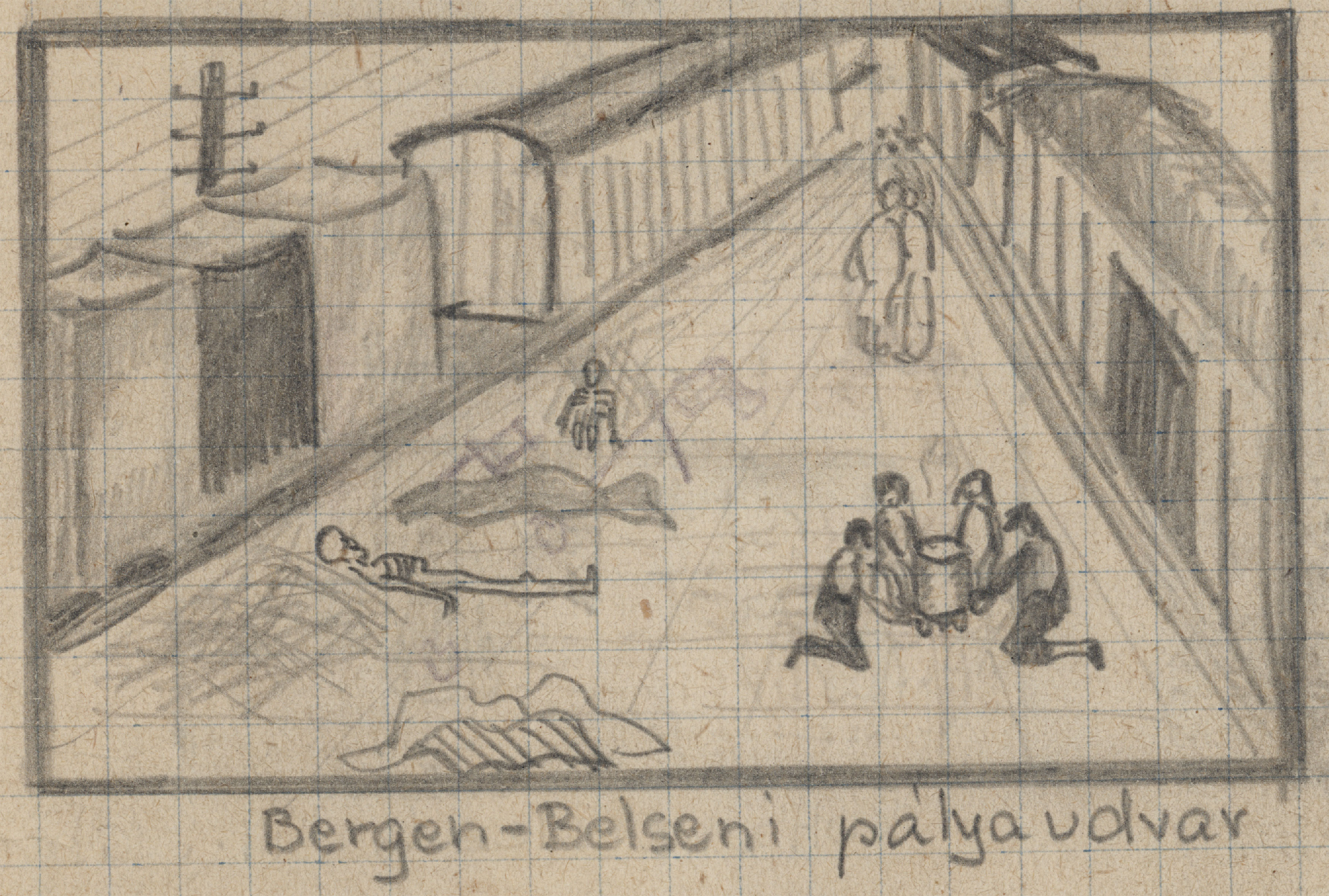
© Bergen-Belsen Memorial
“Endless rows of prisoners came towards us.” Weiter
The starving prisoners marched in blue and white striped clothes. Those who couldn’t continue were kicked aside by their kapo and remained on the ground until they died or were shot.
When we arrived at the station, we saw trains full of prisoners. Here, too, people on the verge of death lay on the platform. It was hard to call them human; so thin and starving, they looked like skeletons. Some of them tried to get up because they knew that if they remained on the ground, death would be inevitable; but they were too exhausted and fell back down.
“We saw the docks full of people.” Weiter

They had to walk in miserable rows of five heading towards the camp... And they couldn’t go... they held on to each other... And in the middle, they just fell and died... They fell... And just stayed there on the platform.
What was the logic? They had to enter the camp... And we had to get out of it. ... It was so crazy. So crazy.
Outside there was a large pile of beets available to us. We made a small bonfire and sliced the beets into very thin slices, which we “fried” in water in a saucepan we still had. That’s what we ate before we left.
.
How long did it take for the lost train to actually depart?
“After about an hour we could get on the train.” Weiter
The hospital car we were supposed to board was some distance away (at least it seemed so to us), and we barely got there. The three of us got one bench, which is reasonable for a day-trip, but not for a thirteen-day journey when you have to sleep on it.
Then the waiting began. Will liberation slip away for us?
Every extra hour increased the chances of being saved. The night is over and we’re not on our way yet. The British could come at any moment. This inhumane period will come to an end. The next day (10 April) at 11:00 p.m., a whistle was heard, and the train began to move. We’re on our way. Liberation wouldn’t come for now. Thirteen days, the worst of our hell, was still ahead of us.
“The next day towards midnight, the train began to move.”
What were the conditions like during the journey?
The train was completely overcrowded. There were passenger carriages and freight carriages.
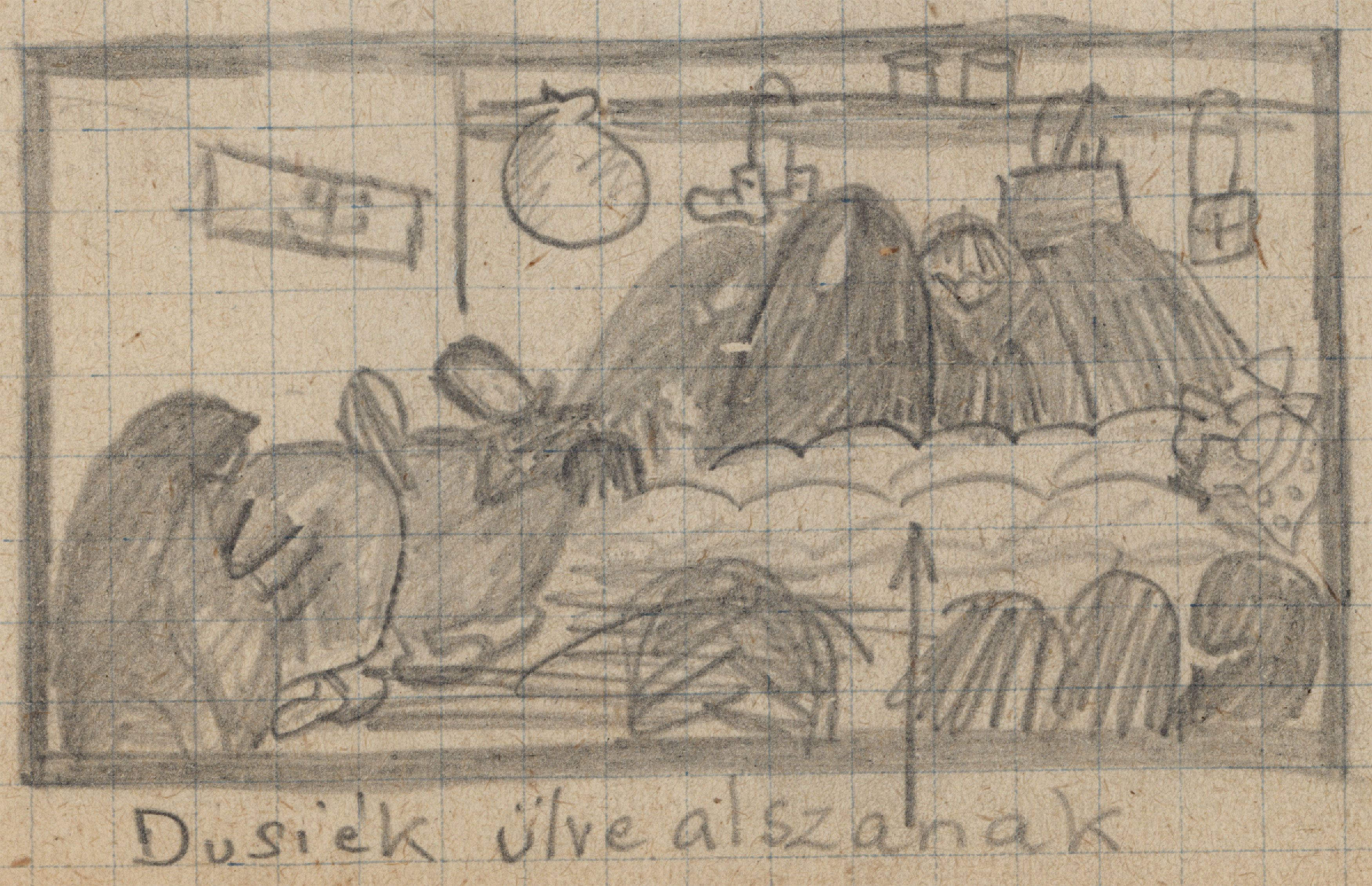
© Bergen-Belsen Memorial
“Some of the carriages were regular coaches.” Weiter
We had a place in a carriage with benches. It was very crowded. There was no place to lie on the benches. We had to sit the entire time. I remember falling asleep, and my head falling forward, and then I’d wake up and fall asleep again, and so on. We sat tightly packed. People moved their legs to create space between the benches, and people took turns lying down and sleeping a bit.
Were the prisoners given anything to eat during the journey?
Some provisions had been distributed before departure. During the journey, the prisoners were occasionally given some bread or other food, but there was almost no water.
“We were left without food and drinking water.” Weiter
We sustained ourselves with whatever we found that was in any way edible, and we drank from the streams we encountered along the way. We were starving, exhausted, sick, and desperate. All kinds of lice and fleas were crawling all over us.
“Chanan was sick. He hallucinated about food.” Weiter
He had spotted fever, and he was pretty confused. He asked for a slice of bread with sugar, a slice of bread with sugar... He drove us crazy. ... It was crazy. He didn’t realize it was the most ridiculous thing, like asking for gold, right here and now! But then he calmed down and got better.
Sometimes there was bread and occasionally some food. Marion was in relatively good shape. She had a white nurse’s apron with her, and during one of the many train stops, she pretended to be on duty and brought us several loaves of bread from a pile on the platform... Until one of the soldiers made a remark.
But there was nothing to drink. That was very difficult. I remember sitting and drinking my saliva, moving my tongue to have something to swallow.
Why didn’t the prisoners escape from the train?
The train was not heavily guarded, but most of the prisoners were too weak and sick to escape.
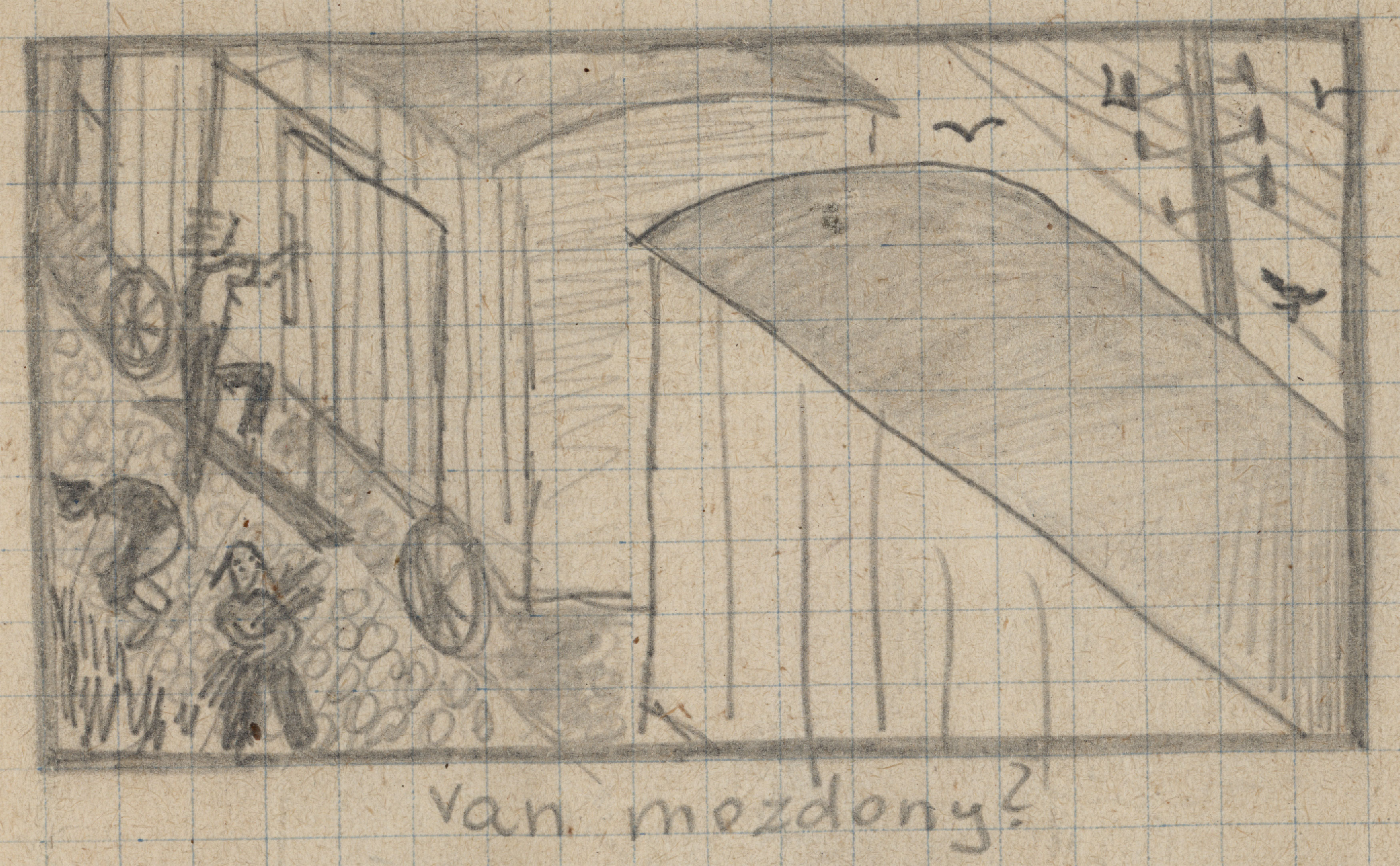
© Bergen-Belsen Memorial
“People were so discouraged that they clung to this train, like... like it was life itself.” Weiter
Why didn’t they go, why didn’t they say... Let’s go.
People were far too weak. And the train was standing in the middle of nowhere, so where could they go... Besides, it was a hostile country; you didn’t know how you’d be received.
Anyway, we all clung to this train like it was life itself.
What route did the train take?
The train travelled through a narrow corridor between the frontlines of the British and the US-American armies in the West and the Red Army in the East. The destination was the Ghetto of Theresienstadt.

© Stadtgeschichtliches Museum Leipzig
“We travelled through a burning and devastated Germany in the last month of the war.” Weiter
Where there was destruction, progress was extremely slow, no more than 50 kilometres a day on average. For many hours or even days, the train stood waiting in open fields or near a forest until our Nazi escorts were ordered to continue.
Why did so many prisoners die on the train journey?
The train’s occupants died from hunger, disease and exhaustion. There were also fatalities during Allied air raids that hit the train.
“We were frequently attacked by Allied planes despite the white makeshift flags we attached to the roofs of the carriages.”
“I remember the train was in Wittenberge, and there were a lot of bombings. We were ordered out.” Weiter
There was a smoke curtain; we were told to go inside the smoke so they wouldn’t see us... Because we were merchandise, and we had to somehow be “protected.” I remember it stinging in my face, in my eyes.
Father didn’t want to get off the train anymore. He felt too weak and couldn’t do it. It was dangerous for him to stay inside; three people who stayed behind were hit and died.
“Every day of the journey, we buried the dead by the side of the tracks whenever we had the chance.”
“But there were times when there was no time to bury them, and then they were pretty much just thrown out, and the train continued...”
“And then, Father’s condition got worse and worse.” Weiter
He lay down and did not get up again.
And I remember that we took care of him and washed him. We tried to keep him clean. He was lying on a bench. By then, of course, there was more space on the train. He was lying on the bench, and I was sitting there.
I sat very close to Father in the last minutes of his life – how long was that?
Fifteen minutes? Half an hour? An hour? I don’t know. I was sitting on the edge of the bench where Father was lying. I knew he was going to die; I knew it was so obvious. ... I was sitting there waiting... and then it happened... And he was gone.
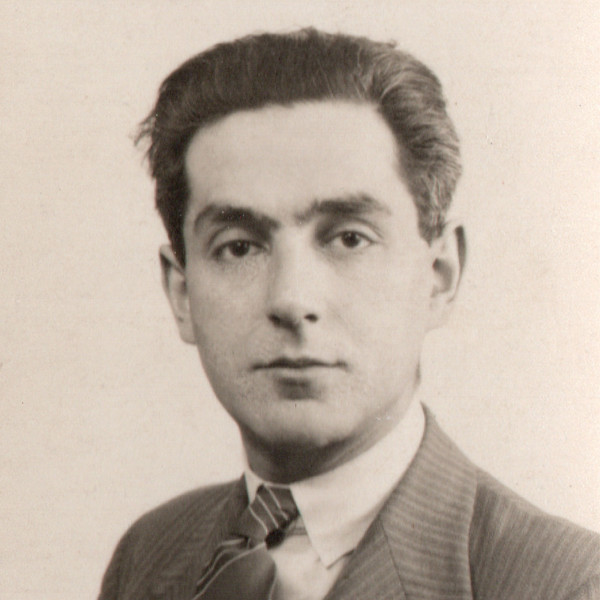
Sander Tal
1903 – 1945
“My father faded away from hunger and general exhaustion on the night of 21 April 1945, 8 Iyyar 5755 in the Jewish calendar.” Weiter
He was forty-one years old at his death. May his memory be blessed. Two days after Father died, we were liberated by the Red Army soldiers. A liberation that would not have saved Father even if it had come a few days earlier.
The following morning, 22 April, they came to pick up Father.
Mother suggested that Father be placed in the grave, wrapped in the tallit that I was able to keep in my knapsack the entire time, and of course, I agreed.
Father was buried, wrapped in the tallit, with fifteen other people in the shallow mass grave that was prepared next to the railroad tracks.
“The following morning, 22 April, they came to pick up Father” Weiter
Mother suggested that Father be placed in the grave, wrapped in the tallit that I was able to keep in my backpack throughout the entire period, and of course, I agreed.
Father was buried, wrapped in the tallit, with fifteen other people in the shallow mass grave that was prepared next to the railroad tracks.

Transcription
Josef Weiss, the camp elder of the Star Camp, recorded in a small notebook everyone who died on the Lost Train. He included their names, the date of their death, the exact burial place, and their birth country.
The information in this list of deceased persons is based on Josef Weiss’ notes.
When and where were the exchange prisoners liberated?
The Red Army liberated the Lost Train near the village of Tröbitz on 23 April 1945.
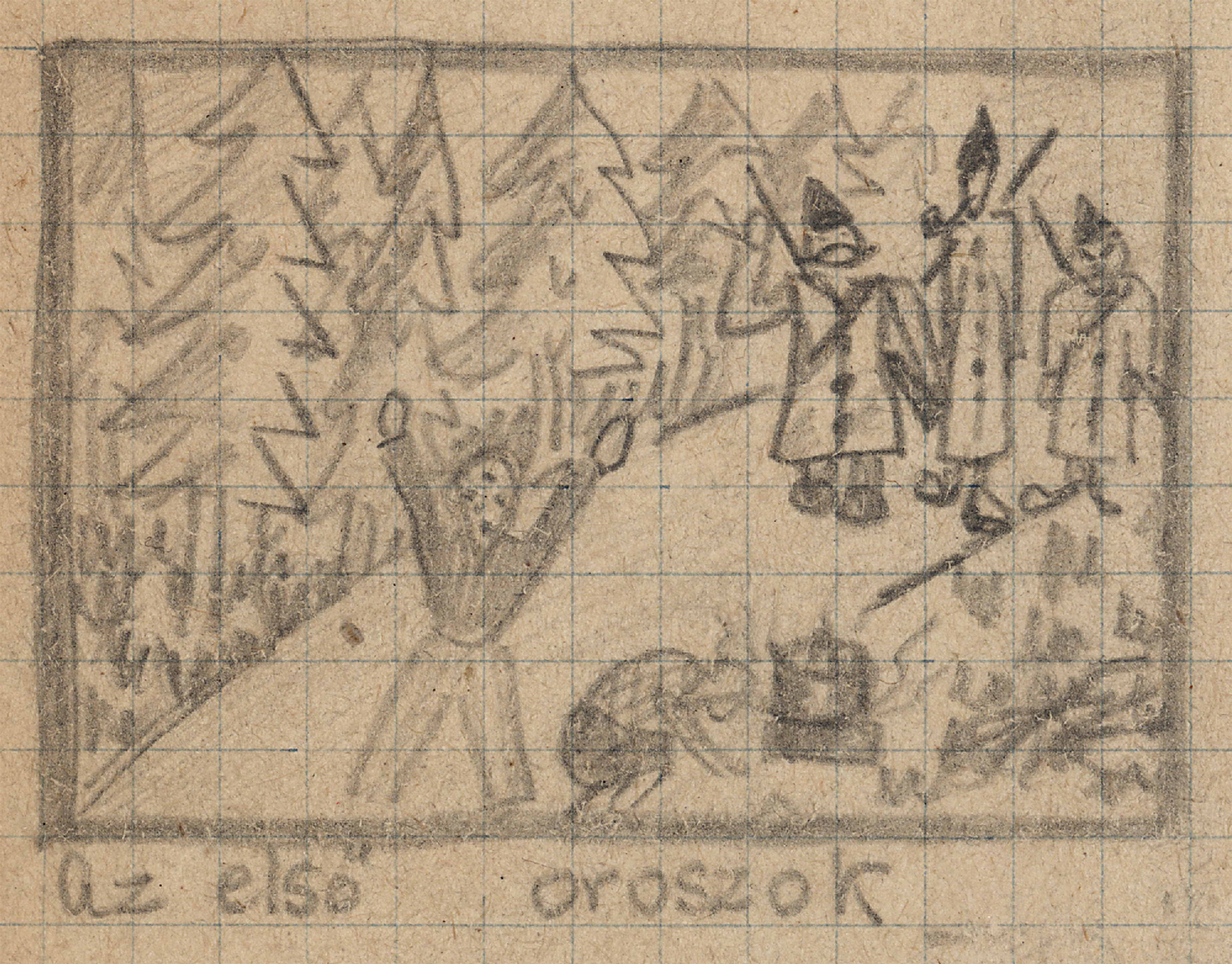
© Bergen-Belsen Memorial
“At the end, silence.” Weiter
The train is in Tröbitz.
Beautiful spring weather.
On a horse, there appeared a soldier of the Red Army.
We understood that we were free.
A big day; we were saved.
“We’ve been liberated!” Weiter
The Red Army soldiers liberated us! And I remember looking out the window and seeing one Russian soldier on a horse.
I was once asked if it was a happy day. No, it wasn’t a happy day.
We talked all the time about the day they would liberate us... You think life will be the same as it was before. Of course that was not the case. Father had died just two days earlier...
“Mother was already very weak, and Joost was skinny as a skeleton.” Weiter
I stood up and felt terrible nausea, nauseous from hunger. Now I had to get off the bench. It was difficult. There was nowhere to put my feet. I stepped on heads and legs. Outside there were only a few people wandering around. I had to go down the stairs; almost no one was capable of this anymore. It was a great effort for me, too; I was so weak.
“Mother was already very weak, and Joost was skinny as a skeleton.” Weiter
I stood up and felt terrible nausea, nauseous from hunger. Now I had to get off the bench. It was difficult. There was nowhere to put my legs. I stepped on heads and legs. Outside there were only a few people wandering. I had to go down the stairs; almost no one was capable of it anymore. It was a great effort for me, too; I was so weak.
Why did the freed prisoners have to take care of themselves at first?
The Red Army ordered the Germans to evacuate the village of Tröbitz. Most of the Soviet soldiers quickly moved on.
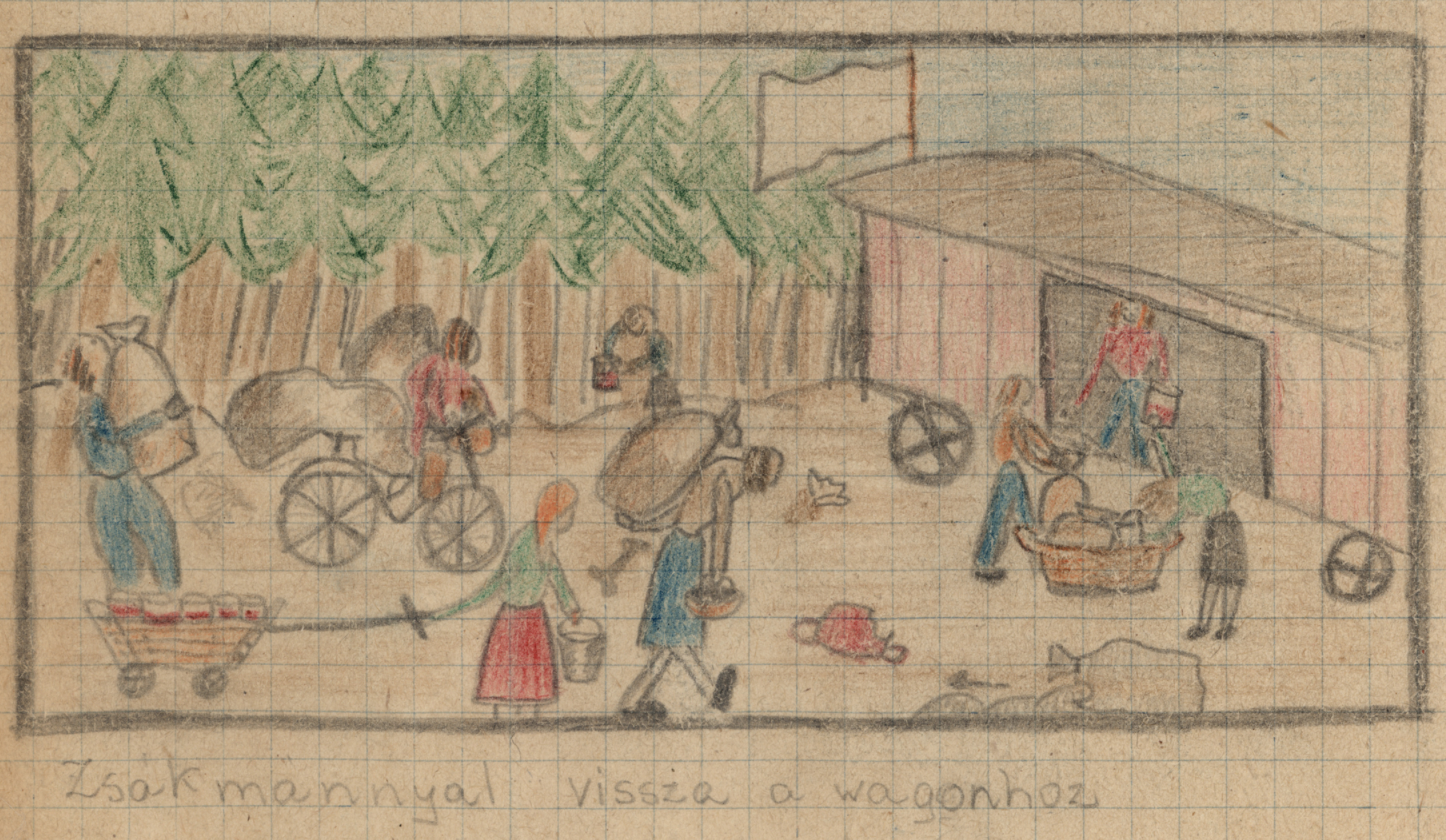
© Bergen-Belsen Memorial
From the moment she was liberated, Susanne Schuller used coloured pencils she had found in Tröbitz to make her drawings. In this one she shows survivors bringing their “booty” to the train. They wanted to use the food to feed those who had stayed behind.
“The Russians told the villagers to move and make room. And that’s what the villagers did.”
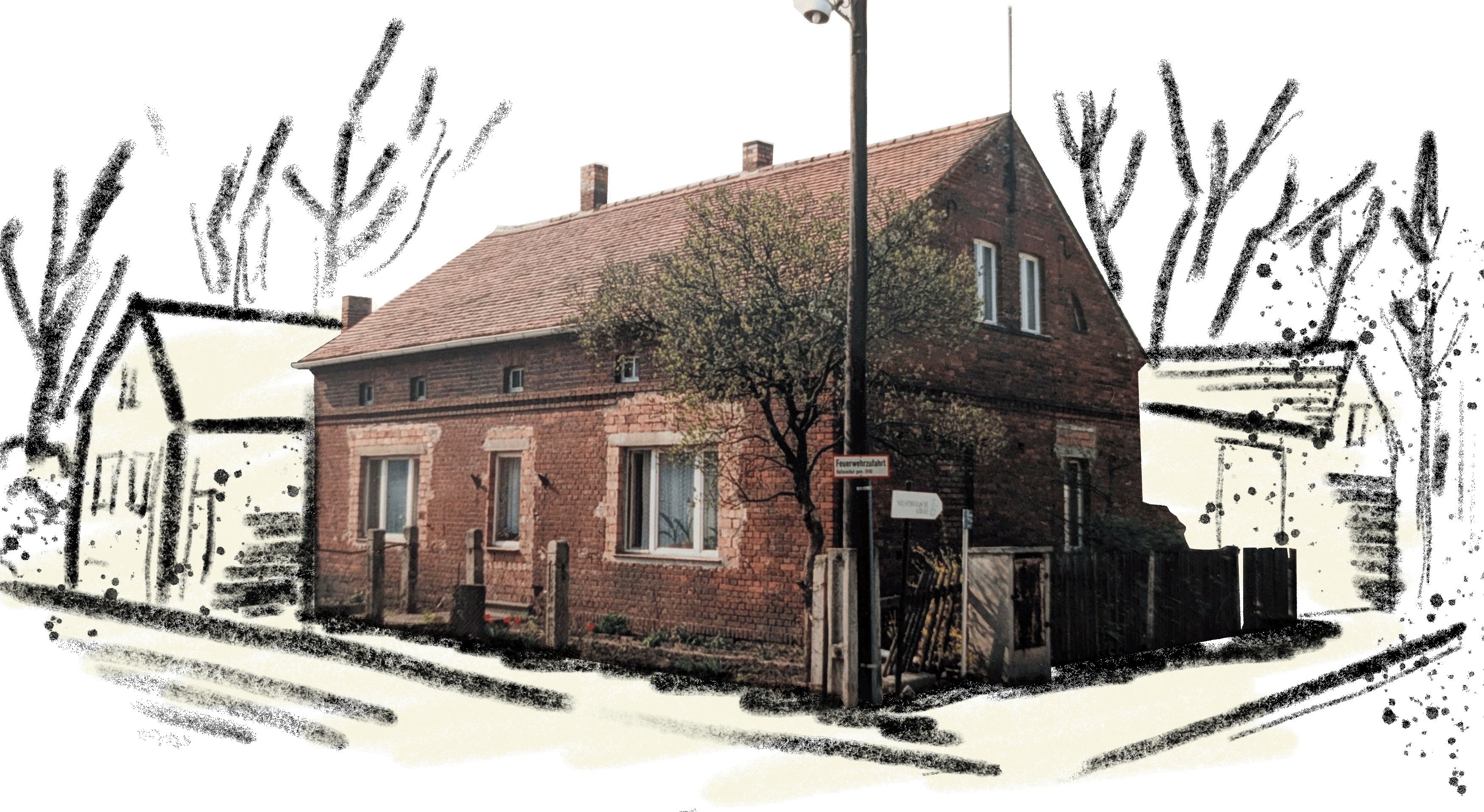
© Private property of the Tal family
The villagers had vacated the house at 15 Schulstraße. The Tal family moved in with another family.
“Anyone who was strong enough got off the train to look for food... to look for a place to stay.” Weiter
I didn’t go out with everyone. I had no strength. I was sick and was left lying on the empty bench in the carriage. A while later, Marion came and took me on a bicycle to the house whose occupants had fled and where we had moved in. We were two families there, Mother with the three of us in one part of the house, and Izak de Vries with his wife and two children in the other. They made room for me in a double bed I shared at night with Marion and Mother. From that moment on, I remember almost nothing.
After two weeks of almost continuous sleep, my fever started to drop, and I slowly began to wake up.
How did the villagers react to the evacuation and to the freed prisoners?
The residents of Tröbitz claimed to have known nothing about the crimes committed by the Nazis.

© Bergen-Belsen Memorial
Susanne Schuller drew a resident of Tröbitz: The woman hides a portrait of Hitler under a chest of drawers. Then she takes it out again and burns it in the oven.
Many Germans denied having ever supported National Socialism or benefitted from it. They feared that their support might be discovered if the Red Army soldiers came back.
“The residents of Tröbitz repeatedly claimed that they didn’t know...” Weiter
Mother would quote them and sneer: “Wir haben es nicht gewusst!“ (“We didn't know, we didn’t know!”). That no doubt was true: the Nazi propaganda did not focus on what was going on in the different camps. But that does not mean that it was impossible to know. They did not know because they were not interested, did not ask questions that should have been asked, did not delve, and did not wonder about the situation that had been created.
“It was more convenient to ignore, to be indifferent... and not to know.”
Why did so many former prisoners die in Tröbitz after liberation?
The liberated prisoners died from the effects of imprisonment: malnutrition, exhaustion and diseases they had contracted in Bergen-Belsen.
“Mother got very sick and feverish.” Weiter
A week and a half after we arrived, Mother got very sick and feverish; she had spotted fever. We were promised they’d move her to the hospital. But no one showed up.
One day, when I got home, she was unconscious. As much as I cried and called to her, she didn’t answer. Suddenly I heard Joost say, “Don’t you realize she’s dying?!” Until that moment, I didn’t want to acknowledge it.

Elizabeth Goudeket-Levenbach
1894 – 1945
“My mother died on 15 May 1945, 3 Sivan 5755 in the Jewish calendar, five minutes to midnight.”

© Erika Arlt / Bergen-Belsen Memorial
Because so many people died after the liberation of the Lost Train, a separate Jewish cemetery was established next to the Christian cemetery in Tröbitz.
“She was buried in the Jewish cemetery in Tröbitz.”
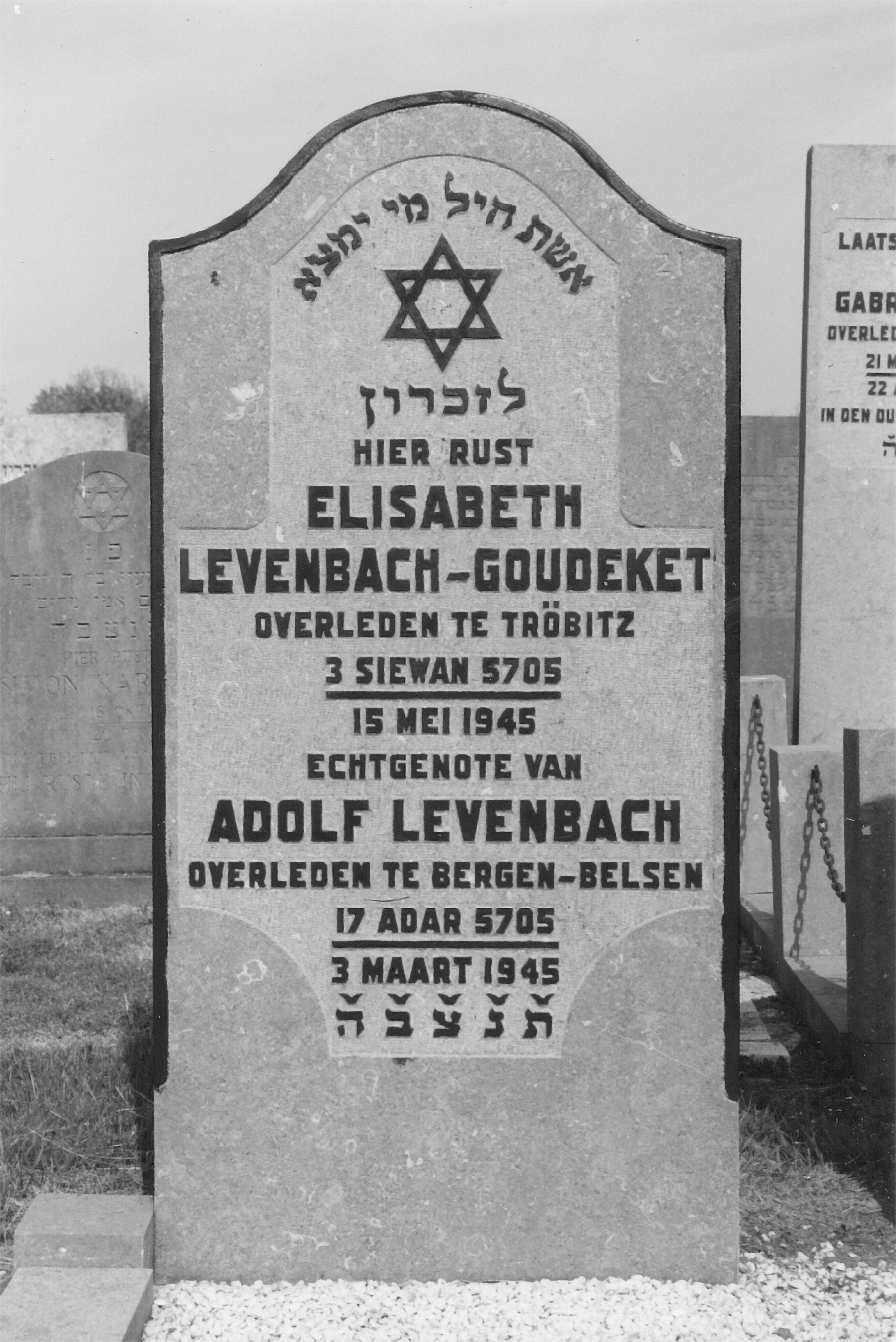
© Private property of the Tal family
Transcription
Died in Tröbitz
3 Siewan 5705
15 May 1945
Wife of Adolf Levenbach
Died in Bergen-Belsen
17 Adar 5705
3 March 1945
“Four years later, her bones were buried in the Jewish cemetery of Muiderberg, near Amsterdam.”