




Exclusion

How did the children experience the German attack?
The children experienced the outbreak of war as a radical change. They realised that their families were especially threatened by the German invasion.
© NIOD, Beeldbank WO2, No. 64829
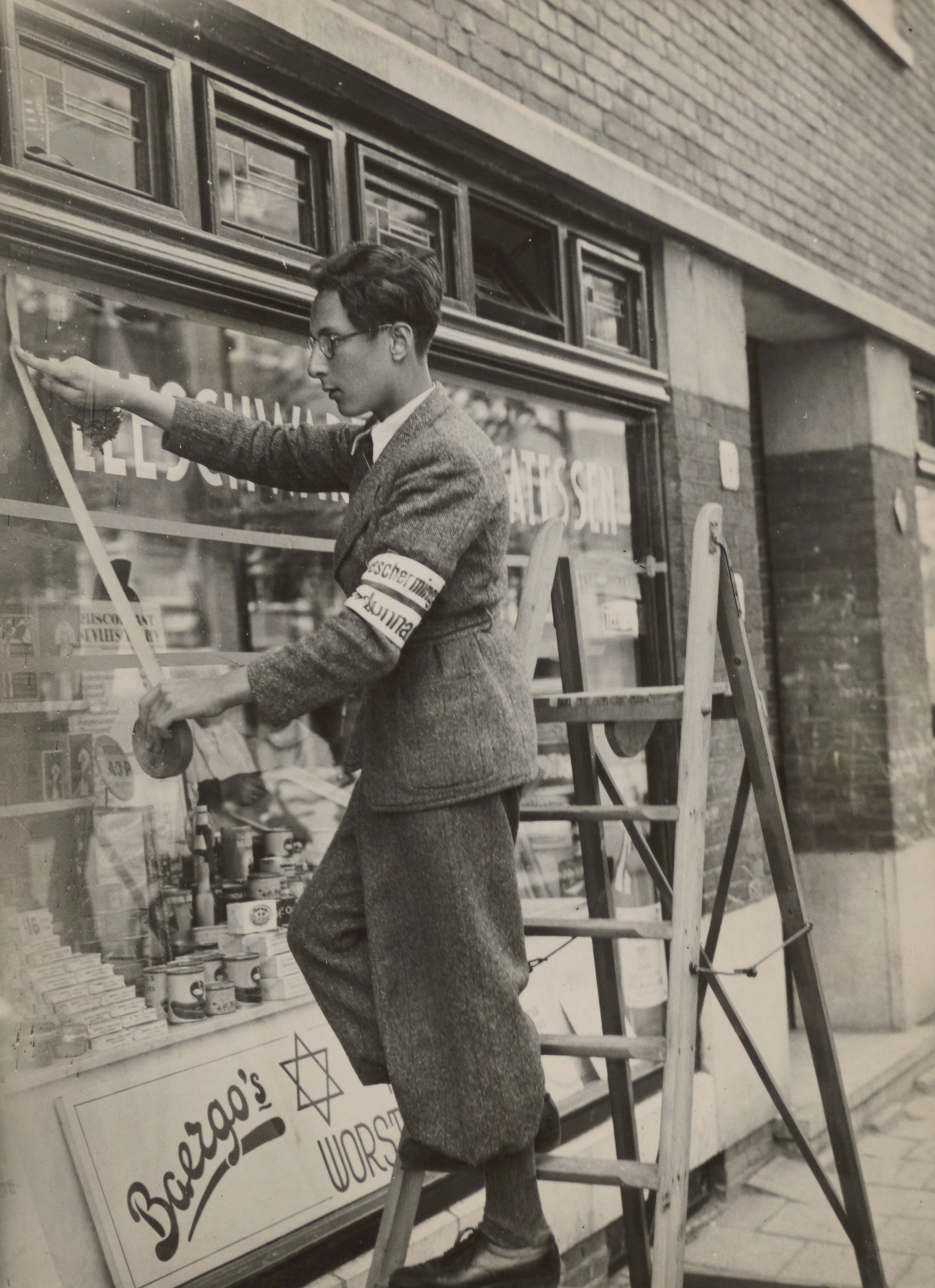
The Dutch air raid protection service consisted of civilians who took precautions and protective measures in the event of an air raid. Members of the air raid protection service wore an armband with the inscription “luchtbeschermingsdienst”.
The air raid protection service applied adhesive tape to shop windows to prevent glass shards from scattering. The shop window of a Jewish butcher shop is seen here.
“There were sirens and Father joined the Civil Defence ‘luchtbeschermingsdienst’.”

“Our family tried to flee to England.” Weiter
On 14 May, we got in the car to drive to the port, but on the way, we got stuck in a huge traffic jam because a few thousand others had the same idea. We couldn’t go any further and had to return home. The trap closed and we were in it.
© NIOD, Beeldbank WO2, No. 64800
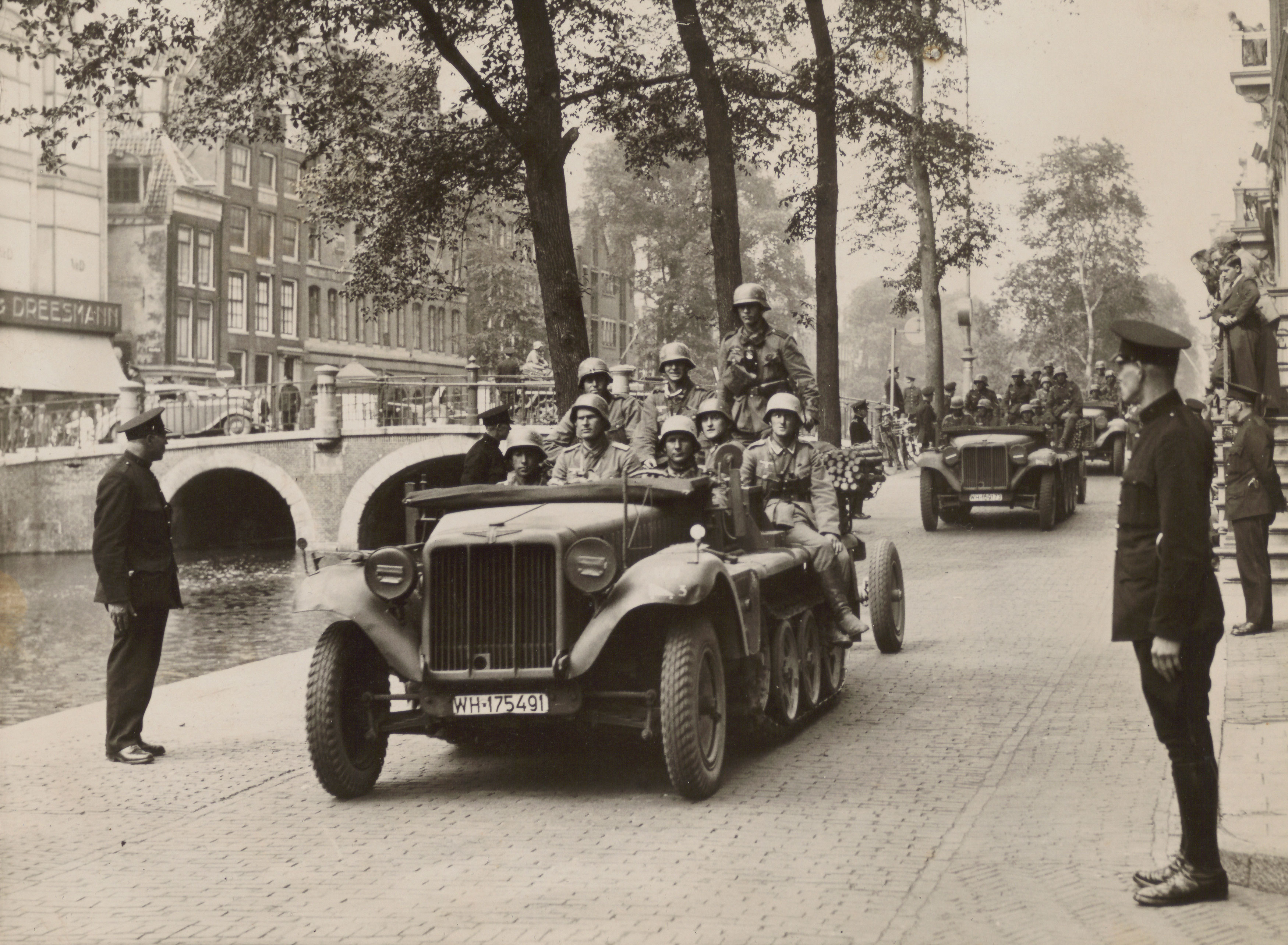
“I remember when the Germans entered Amsterdam.” Weiter
I was on the street with Mother. We were standing in front of a building that was considered very tall at the time and was called the “Skyscraper”, and she was holding my hand. The Germans entered the city on motorcycles. As they passed us, Mother said, “Brennen sollen sie” in Yiddish, that means “Let them burn”.
One can only be disgusted by the speed and ease with which the Netherlands surrendered and by Queen Wilhelmina, who fled to England.
Even those who were not followers of the royal family felt betrayed by the “mother of all”, who abandoned us. The Queen left, accompanied by government ministers, thus allowing the Nazis to impose civilian rule alongside military rule.
When did the German occupiers begin to marginalise Jews?
On 1 July 1940, Jews had to leave the civil air raid protection service. The ban also applied to anyone suspected of being an enemy of the Germans because of their nationality or political views.
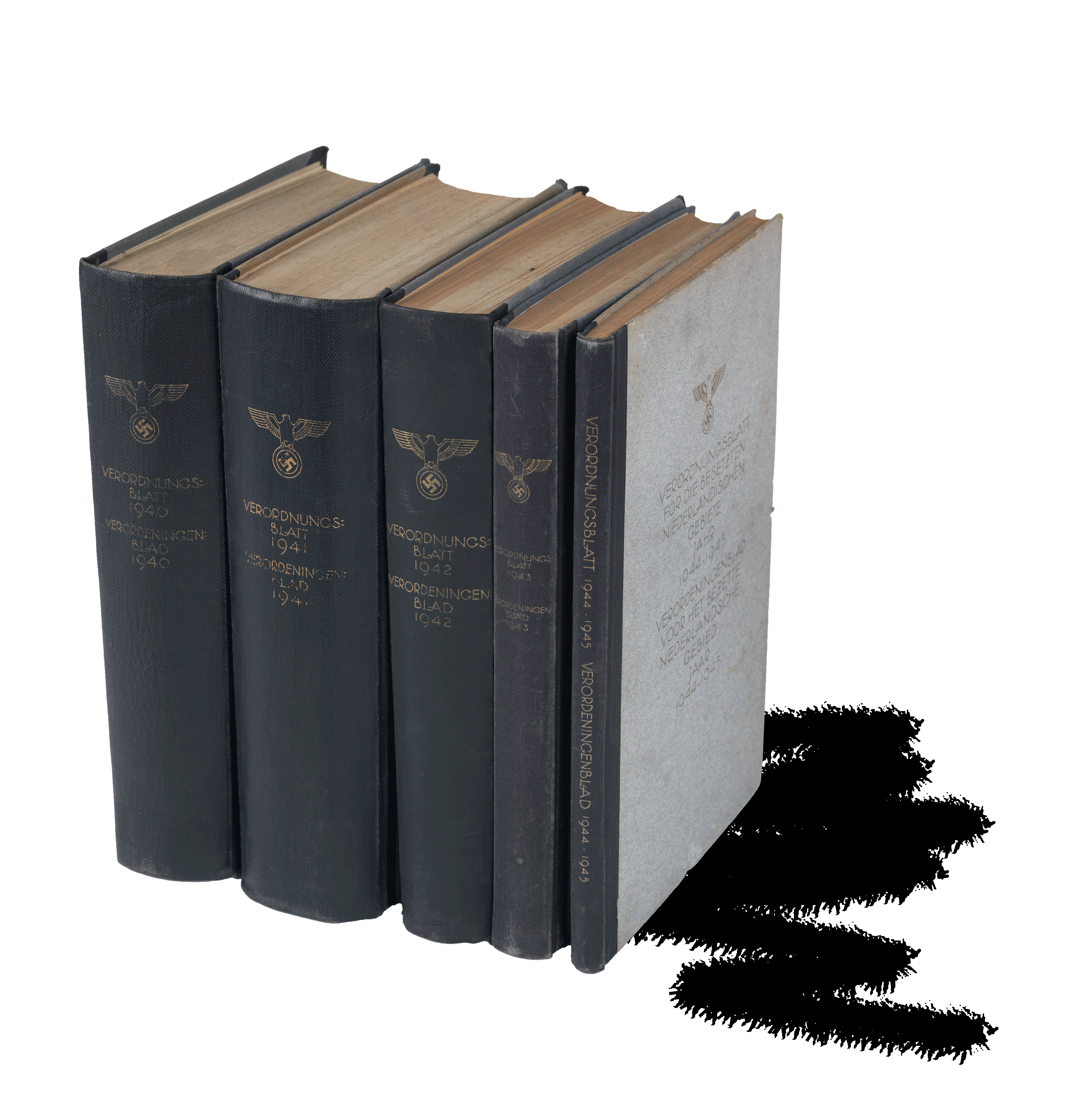
© Collection Jewish Museum, Amsterdam, No. 20020156
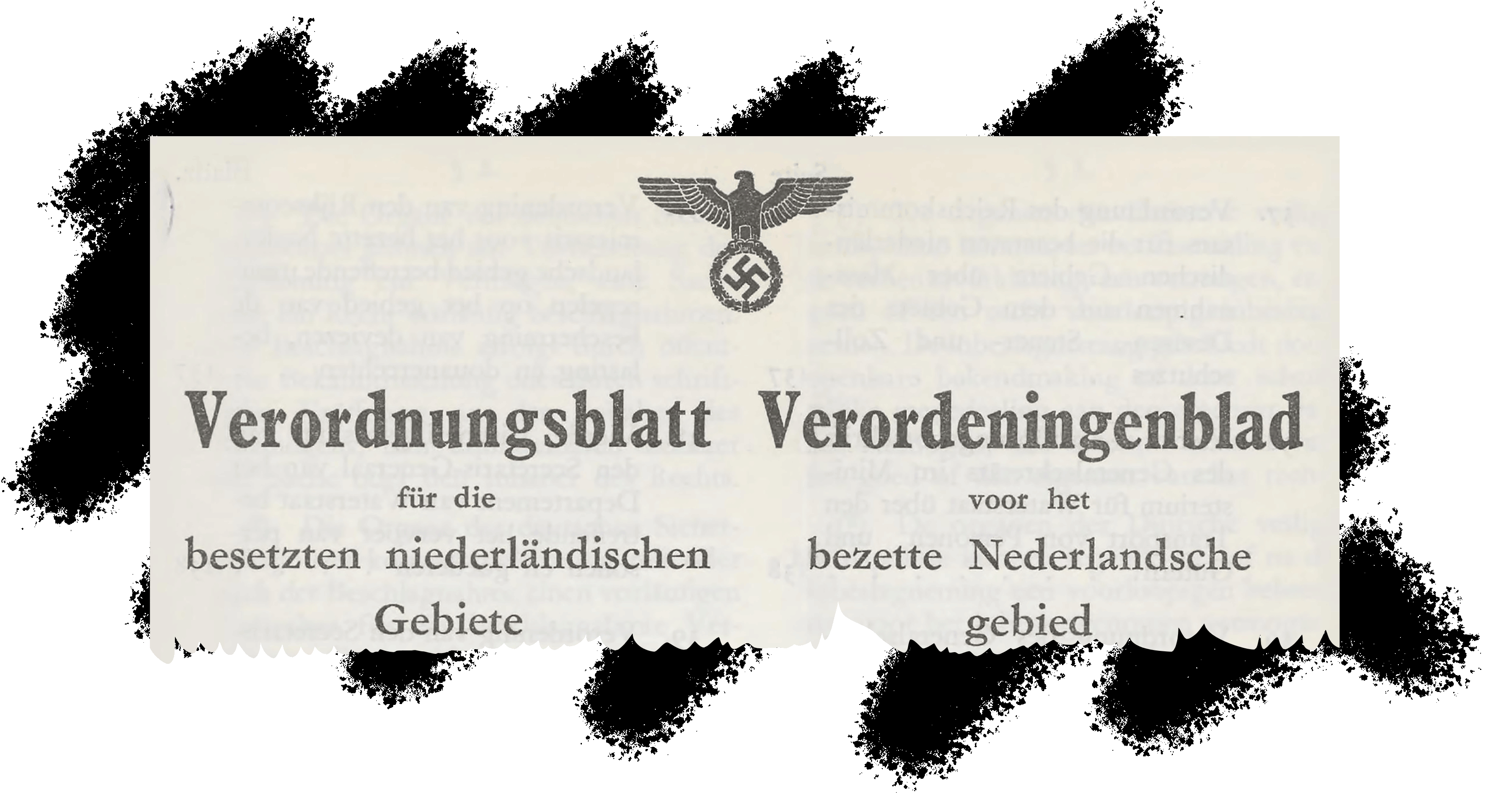
© Koninklijke Bibliotheek / Delpher
Transcription
(left German, right Dutch)
“In the Netherlands, the Nazis took action against the Jews gradually and in stages. First, Father was dismissed from the civil defence against airstrikes.”
“One of the first restrictions imposed on us was a ban on kosher slaughter. But Father took care of us and bought kosher chicken imported from Belgium.”
Why were hundreds of Jews arrested in Amsterdam on 22 February 1941?
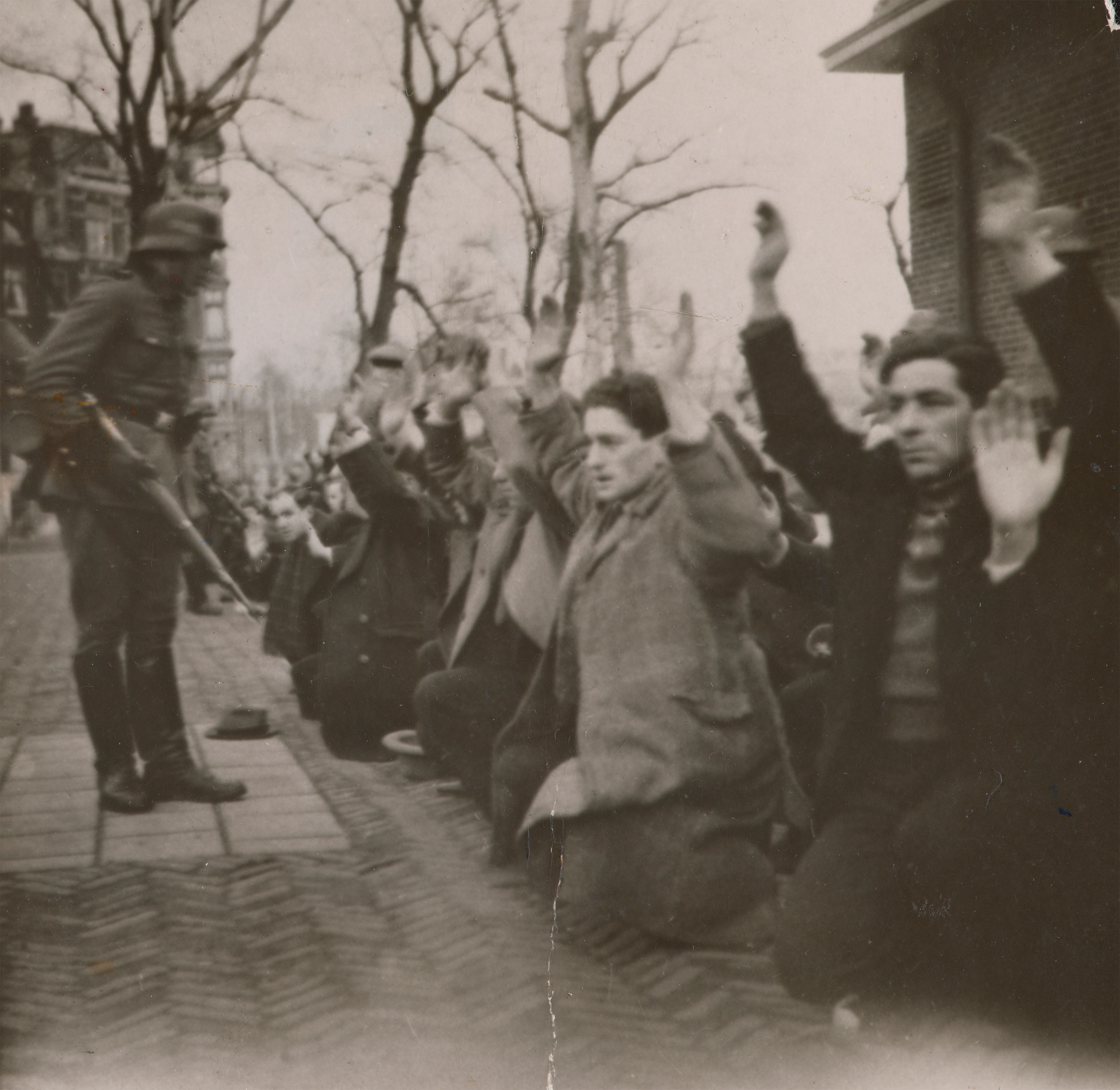
The Dutch Nationaal Socialistische Beweging (NSB) had sought confrontation with political opponents and Jews. The German occupiers responded to the violent unrest with a so-called punitive action.
© NIOD, Beeldbank WO2, No. 97187
© NIOD, Beeldbank WO2, No. 97193
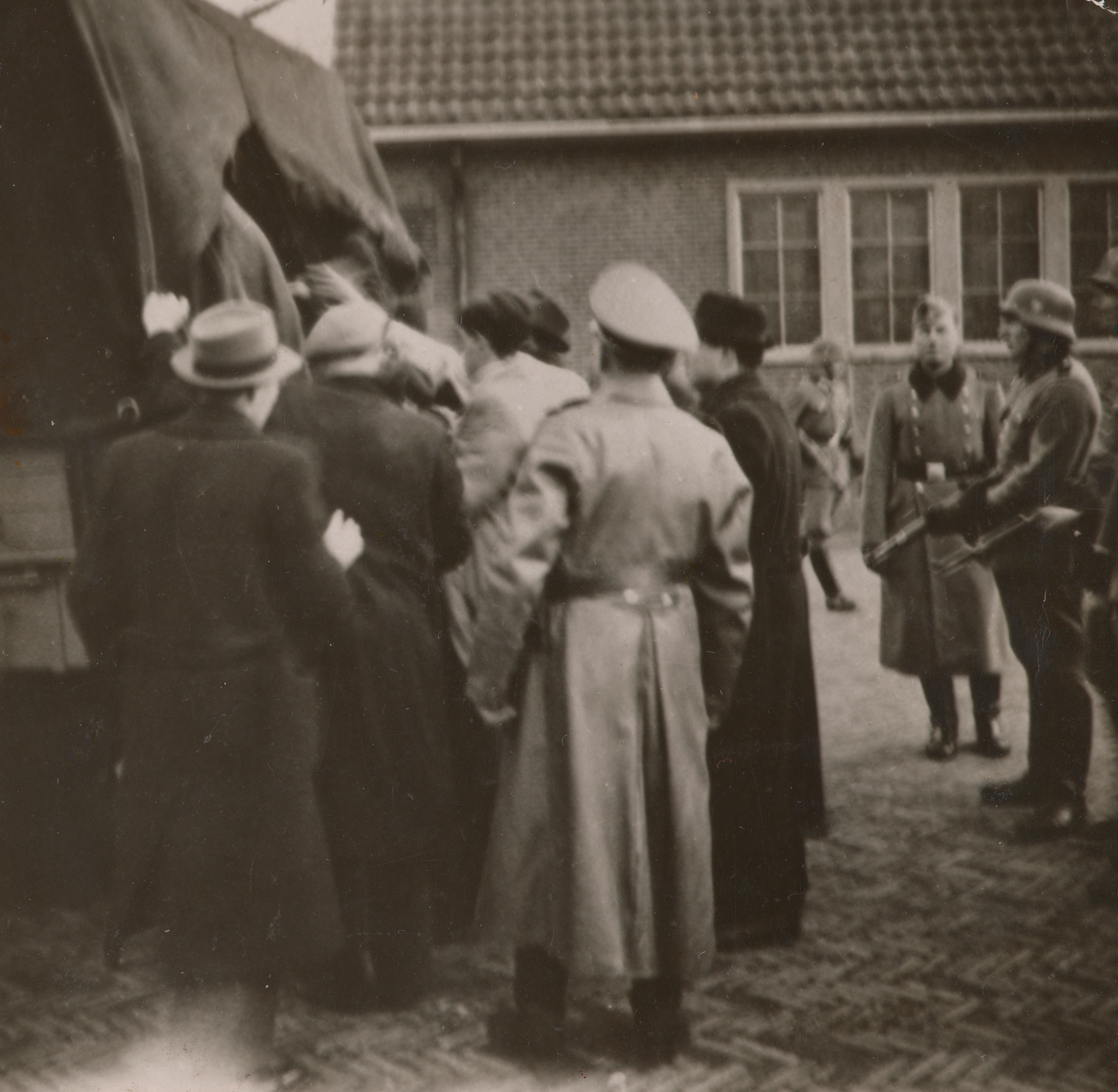
© NIOD, Beeldbank WO2, No. 97188
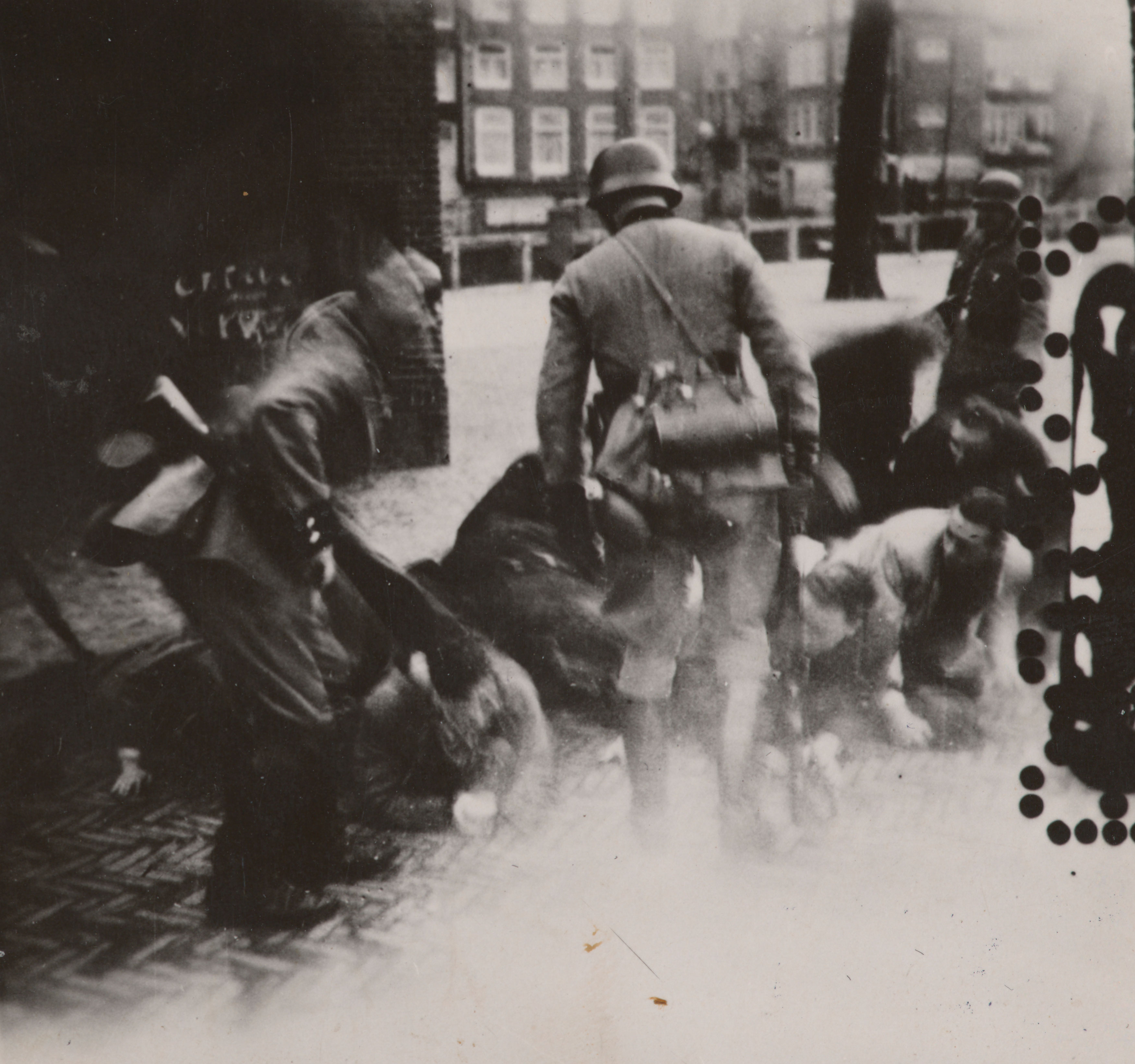
On 22 February 1941, the German police arbitrarily arrested Jewish men in Amsterdam’s Jewish Quarter. This so-called punitive action was ordered by Reichsführer SS Heinrich Himmler. It was the first raid against Jews in the Netherlands.
Those arrested were herded together on the Jonas Daniël Meijerplein, where they were humiliated and harassed. More than 425 Jewish men were transported away in trucks. They were taken to the Schoorl internment camp in North Holland.
Twenty-one photographs of the raid, taken by an unknown German, have been preserved. He was probably a police officer. Prints of the photos were attached to the mission report addressed to Himmler.
“In Van Woustraat, there was an ice cream shop owned by two Jews.” Weiter
They were harassed and attacked by the Germans and the NSB. The rioters kept coming back. To protect themselves, the shopkeepers sprayed ammonia gas at the entrance to the store. The Germans responded with “actions” during which they apprehended hundreds of Jewish men.
How did the people of Amsterdam react to the raid?
The brutal raid caused public outrage and led to protests against the German occupiers and the NSB. Leaflets were distributed calling for a general strike and support for persecuted Jews.
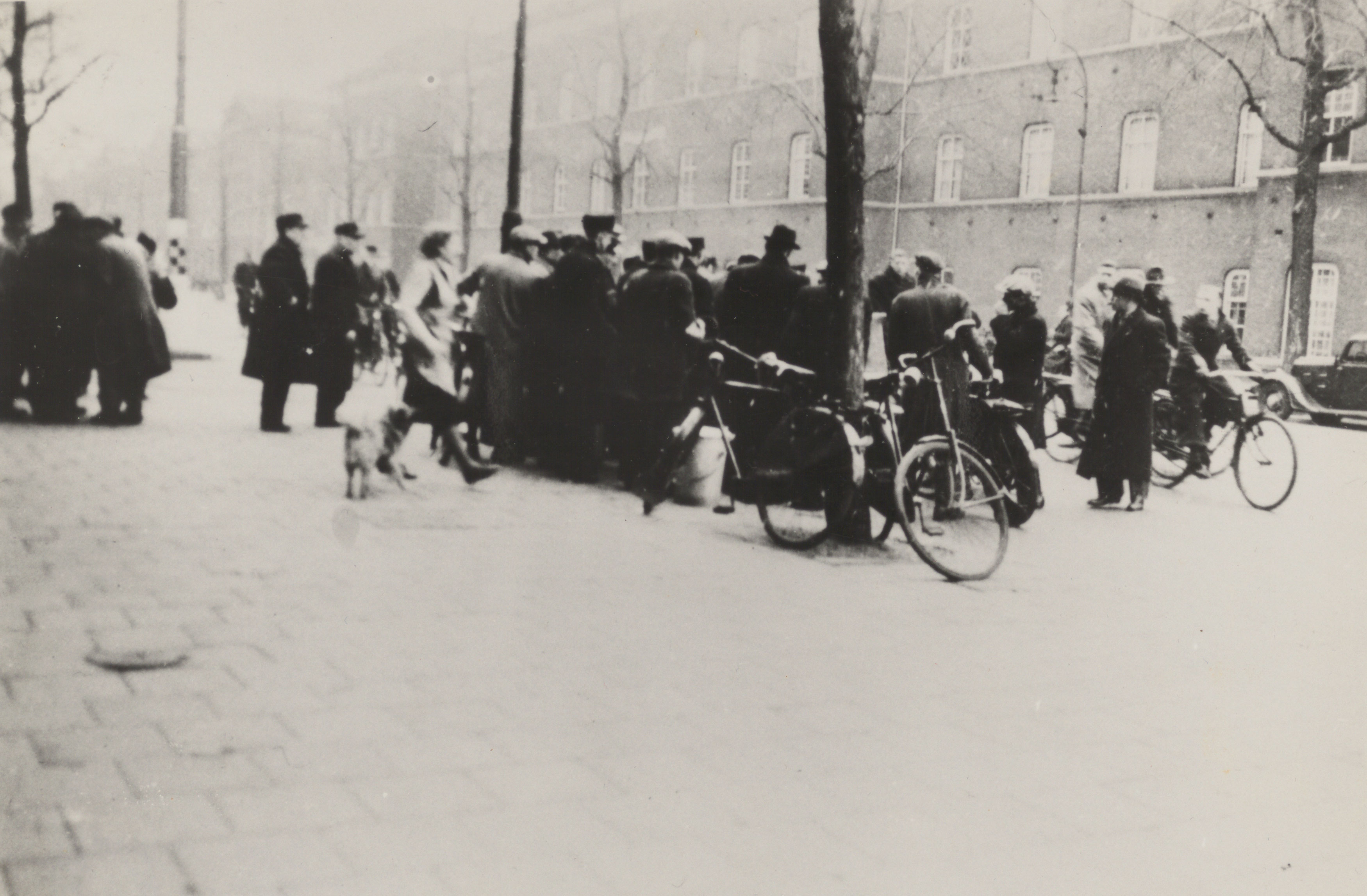
© NIOD, Beeldbank WO2, No. 85769

© NIOD, Beeldbank WO2, No. 85767
Transcription
PROTEST AGAINST THE HORRIFIC PERSECUTION OF THE JEWS!!!
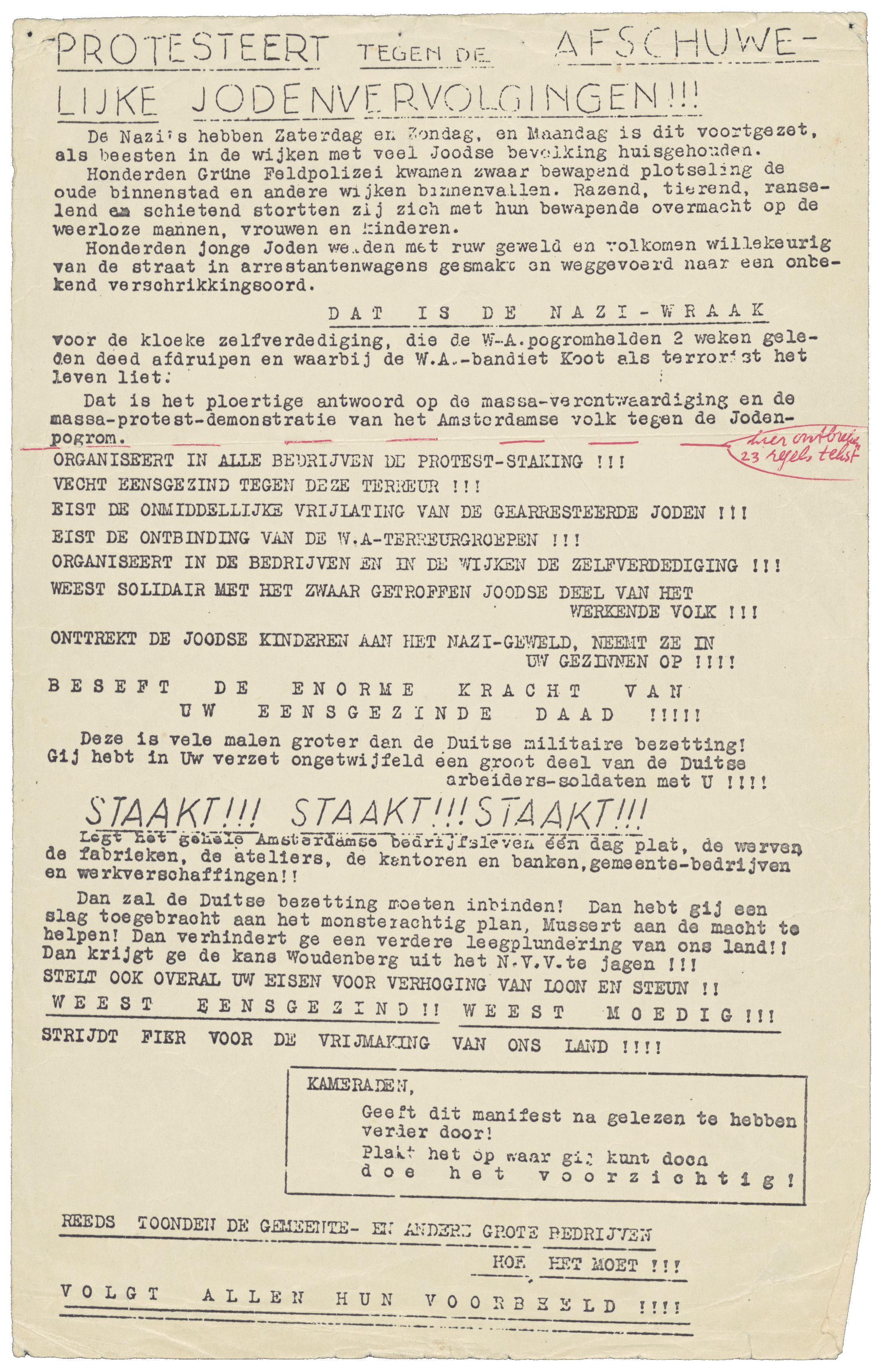
© NIOD, Beeldbank WO2, No. 85768
Transcription
STRIKE!!! STRIKE!!! STRIKE!!!
“I remember how the strike began. It was an attempt by civilians to oppose the persecution of the Jews by the Germans.” Weiter
In protest of the Nazi’s actions, the tram drivers refused to drive, and the few trams that did operate were forcibly stopped by Amsterdam residents.
On Tuesday, 25 February 1941, the strike spread throughout the city within a few hours. All the shops closed, and the protest spread to other cities, as well. German soldiers began firing ruthlessly at civilians, shooting to kill. Nine people were killed and many wounded. The Dutch realised that any resistance could cost them their lives. After the February strike, there was no more public resistance.
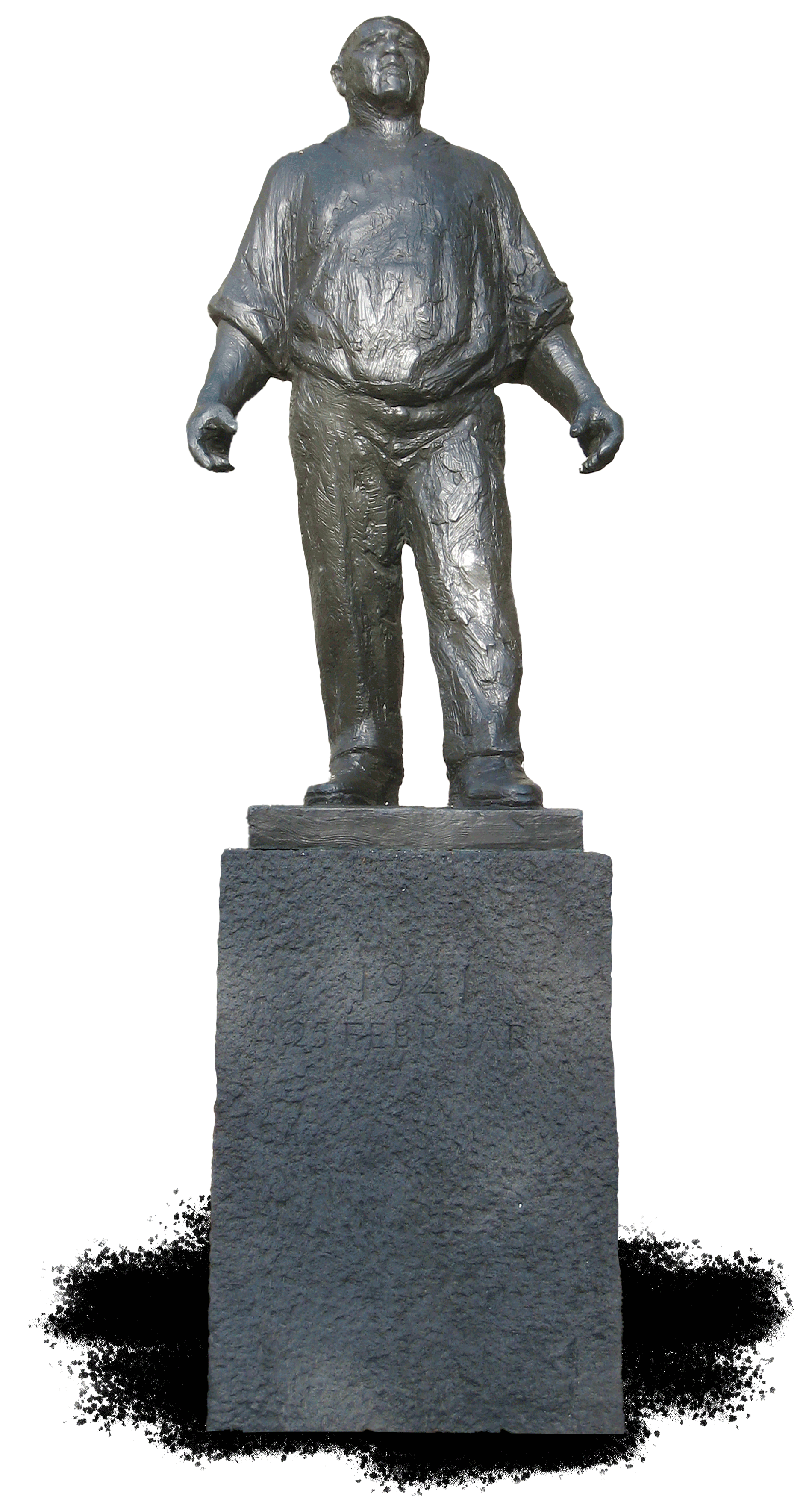
“It is true that the strike failed, but it gave us moral encouragement. In the collective memory, the February strike became a symbol of loyalty to the Jews.”
What did the Germans do with the Jews they arrested?
Most of the Jews arrested on 22 February 1941 were deported to Buchenwald concentration camp and sent from there to Mauthausen concentration camp. None of them survived. In June 1941, there was another raid in Amsterdam.
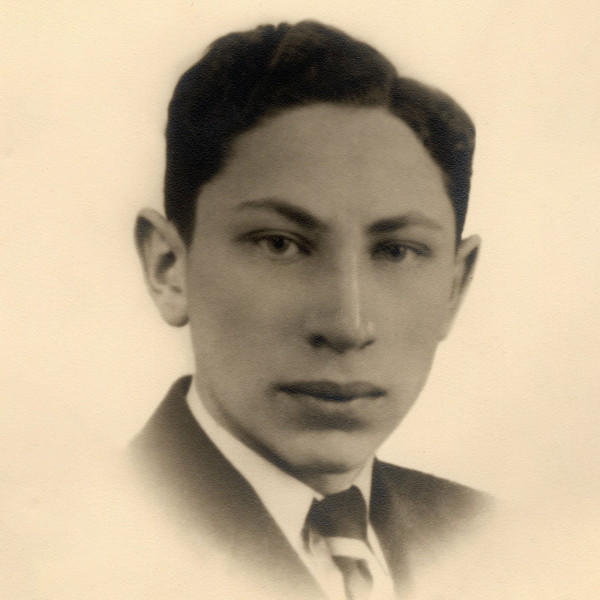
Marco Obstfeld
1922-1941
“On 11 June 1941, the Germans took away Marco Obstfeld. They sent him to Mauthausen. He was only nineteen years old when he died on 13 September 1941.” Weiter
Marco was the eldest son of Uncle Moishe and Aunt Renée, Father’s sister. A few weeks after Marco perished, his parents received a notice that he had died while working. They were allowed to buy his ashes for 30 guilders. I don’t know if they did this or if they sat to mourn for 7 days according to the Jewish tradition. They did not talk to us about what happened. The atmosphere in the family was very difficult. Aunt Renée was agitated, and Moishe was stoic and did not reveal his feelings.
How did the German occupiers identify Jews in the Netherlands?
The Nazis determined by decree who should be viewed as Jewish. The grandparents’ religion served as the criterion. All Jews had to register, otherwise they faced punishment. Very few were willing to take this risk.
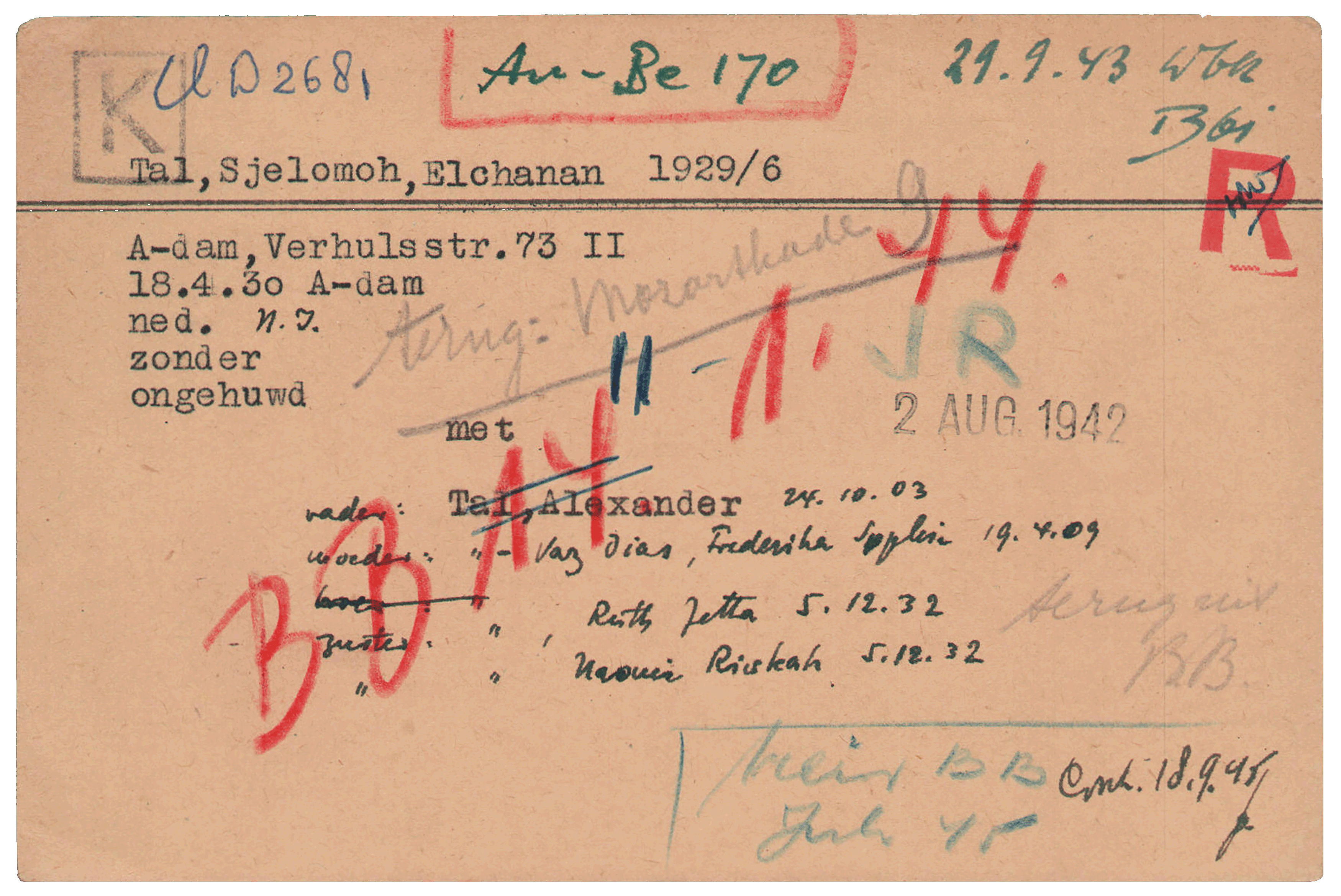
© Collection Jewish Museum, Amsterdam. Donated by the Dutch Red Cross
Transcription
[Address] A[mster]dam, Johannes Verhuls[t]str. 73 II
[Date and place of birth] 18.4.30 A[mster]dam
[Nationality] Dutch
[Profession] none
[Marital status] unmarried
[additional remark] with Tal, Alexander
In autumn 1941, the Jewish Council was required to create index cards for all Jews in Amsterdam. The order came from the ‘Central Office for Jewish Emigration’ of the German security police in Amsterdam.
The ‘Central Office’ later used these index cards to compile the transport lists for the deportation of Jews.
Each index card contained the surname and first name, address, date and place of birth, nationality, occupation and marital status. For children, the name of one parent was added. This general information was later supplemented by handwritten notes or stamps.
“As of 10 January 1941, the Germans demanded the registration of all 140,000 Jews living in the Netherlands at the time, including some 40,000 refugees who had fled Nazi Germany.” Weiter
The Dutch authorities were organised and “helpful”, and the Nazis received accurate data from the Dutch Registry of Residents, including Jews’ home addresses.
The second stage entailed marking Jews. The Nazis ordered all adult Dutch residents to carry an identity card. The cards for Jews were stamped with a red letter “J”, which made it possible to identify Jews quickly at a checkpoint or random inspection on the street.
How did the Nazis exclude Jews from public life?
The German occupiers issued decrees stipulating what was forbidden for Jews. These decrees lent the exclusion an air of legitimacy. Signs in public places drew attention to the prohibitions.
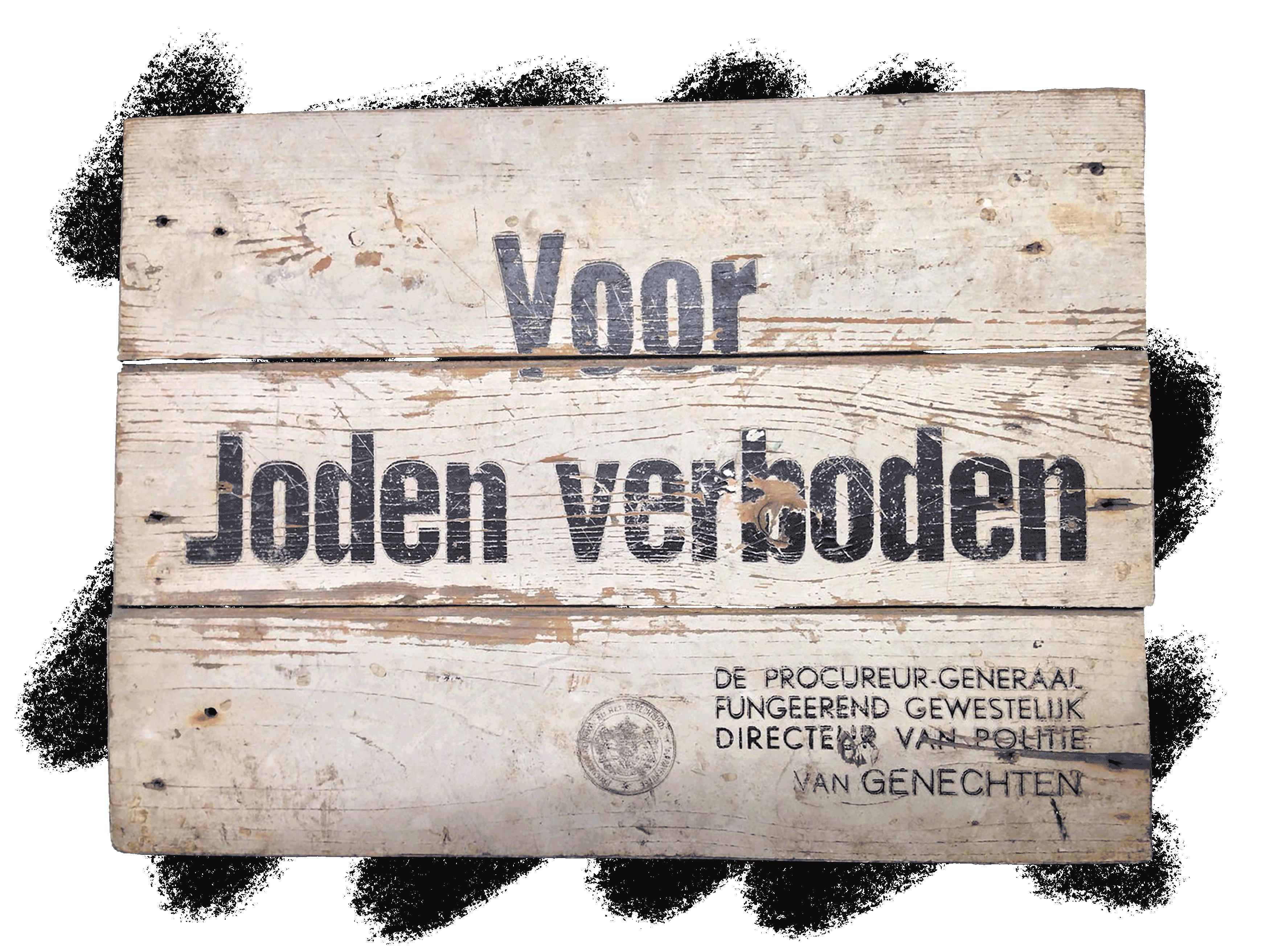
© Collection Anne Frank Stichting, Amsterdam
“The Nazis imposed prohibitions that affected every area of daily life, and there were signs saying ‘No Jews Allowed’ everywhere.” Weiter
We were forbidden from entering restaurants, sitting in cafes, spending time in public parks, watching movies in the cinema, watching football games or other sporting events, shopping at the market, and much more ... Suddenly everything was forbidden to us, even sitting on a bench in the street or going out with a fishing rod and fishing.
The purpose of the orders was to remove the Jews from public life, to restrict freedom of movement, and to isolate them.

© Nationaal Archief, No. 101680
“Like the three boys in the photo, we, too, were no longer allowed to swim.” Weiter
The Germans forbade Jews from boarding a train, bus or tram. Our car was confiscated, and Father had to hand over his bike, too. We were not allowed to own a phone or radio (TV did not yet exist). We were not allowed to be outside the house between 8:00 p.m. and 6:00 a.m. or to visit the homes of non-Jews.
This is the bulk of the decrees that the Germans issued against us, and it gives an idea of what it was like to be marked and isolated from the world around us.
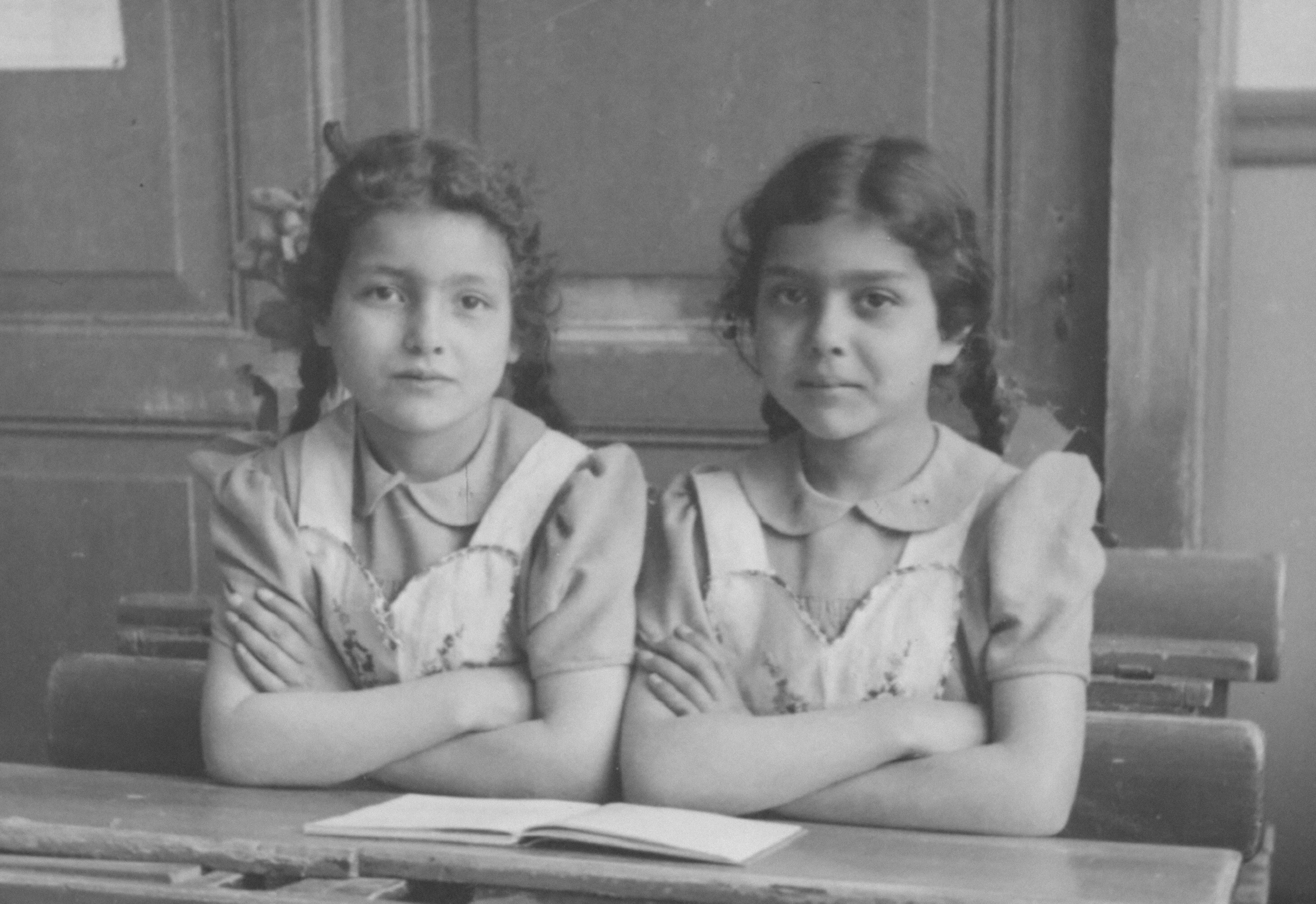
© Private property of the Tal family
“When we started the third grade in September 1941, there were a lot of new kids.” Weiter
They were children who were no longer allowed to attend state schools and had to move to a Jewish school like ours.
The number of students in the class had doubled. Our teacher now had to deal with fifty-six students aged 8-9 ... but how?
“In September 1941, after I graduated from fifth grade, Jewish children were banned from state schools.” Weiter
This was the next level of isolating Jews from society. Thus, after five years at Bentveld State Elementary School, I had to move to a Jewish school in Haarlem. Every day, Joost and I took the tram from Bentveld to Haarlem. He went to the Jewish Gymnasium, and I went to the 6th grade in elementary school.
I joined a class where all the children came from different schools in Haarlem, Zandvoort and other places nearby and were strangers to each other. It was a big mess, with kids from all different backgrounds, and it was difficult to manage a proper set of lessons. Nevertheless, I felt “at home” among these children who shared a common destiny with me.
Why did thousands of Jews have to leave their homes and move to Amsterdam?
The German occupiers wanted all Jews to be in Amsterdam and a few other large cities, where they had to live in special areas. This made it easier to arrest them at home or during checks.
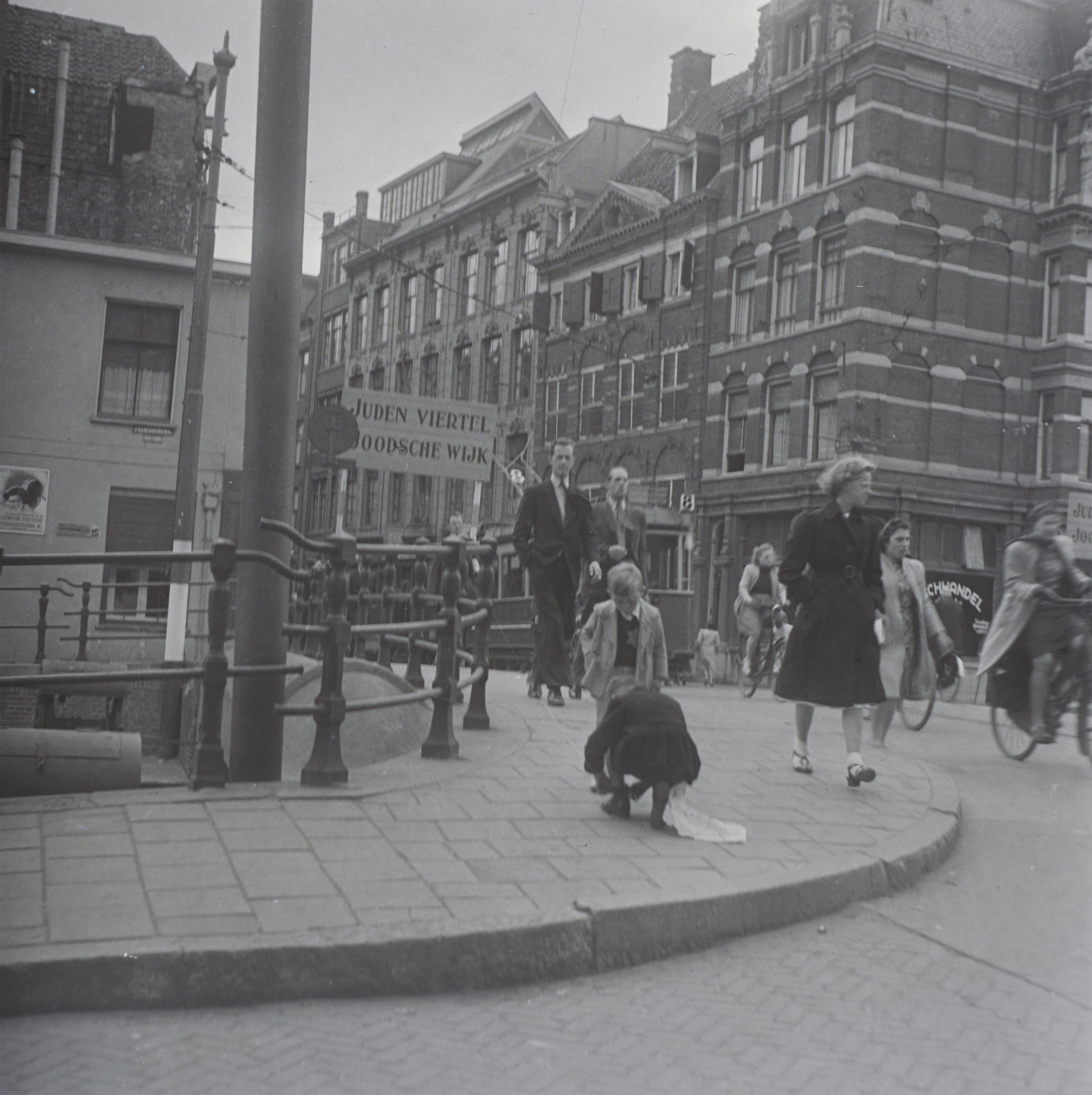
© Stadsarchief Amsterdam, No. ANWX00486000518
Transcription
“The concentration of the Jews in Amsterdam began on 17 January 1942.” Weiter
In the following months, many thousands of Jews who lived in cities and villages throughout the Netherlands had to move to Amsterdam.
Since there was not enough room for all the Jews from outside the city to be housed in the crowded old Jewish Quarter, some were moved to two other areas of the city, where there were already many Jews. Some of them had already been deported to camps and left empty homes behind.

© Private property of the Tal family
“In early 1942, all Jews were expelled from Bentveld and forced to move to Amsterdam. A Nazi moved into the beautiful house we were forced to vacate.” Weiter
Since we didn’t have a home in Amsterdam, we stayed with my father’s brother, Uncle George, and his wife, Aunt Martha, on Pieter de Hoochstraat. It wasn’t easy. Fortunately, after a month, we were able to use the vacant apartment of Aunt Ri, the first wife of Uncle Max, my father’s older brother, where we lived in secret because we were officially registered at the home of Uncle George and Aunt Martha.
Since my parents thought it was too dangerous to live in secret, we went back to our uncle’s house at night to sleep. We had to walk about half an hour to reach his home by 8 p.m., when the curfew imposed on the Jews, began. To shorten the distance, we crossed the Amstel Canal on a tiny ferry. It was the only vehicle that Jews were still allowed to use.
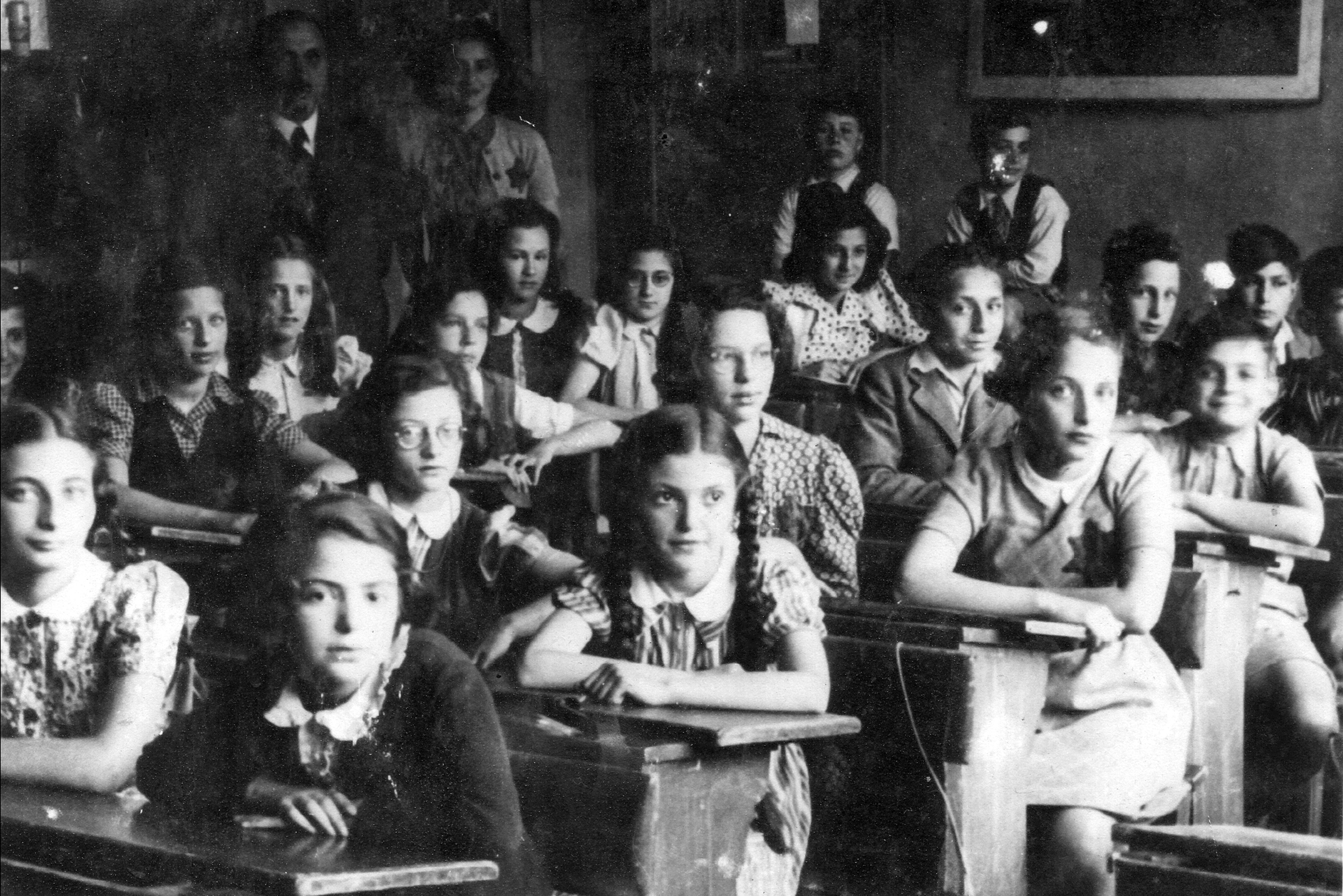
© Private property of the Tal family
“Following the move to Amsterdam, I transferred to a Jewish school in Amsterdam. I was still in sixth grade.” Weiter
I was considered a stranger, and I was miserable. School, which I’ve always managed very easily, didn’t work out for me now. I’d been behind since Haarlem, where we hardly learned anything. The teacher had no patience or understanding for my difficulties. In class, I couldn’t keep track of the lessons and was mostly daydreaming.
At the end of the year, I was the only one who wasn´t allowed to take the high school entrance exams. With the help of the principal of Bentveld Elementary School, who testified that it was the difficult circumstances that made me a weak student, I was able to go to the Jewish high school without entrance exams. [...] At this school, I studied for a few more months. It was fun. Every morning [my] girlfriends [...] picked me up with an old stroller into which we threw all our books, and together we walked three-quarters of an hour to school because we were not allowed to take the tram.
Why did the German occupiers mark Jewish people?
The yellow badge made Jews recognisable to everyone at all times. It excluded them from Dutch society, as if they were foreigners. At the same time, the NSB and the German occupiers intensified their antisemitic propaganda.

© Collection Jewish Museum, Amsterdam, No. D020926
“As of 3 May 1942, every Jew aged 6 and over had to wear a yellow Star of David with the word ‘JOOD’ (Jew in Dutch) in its centre. It was stitched securely onto the garment, on the left side of one’s chest, and to infuriate us, the lettering was designed to resemble Hebrew writing.”
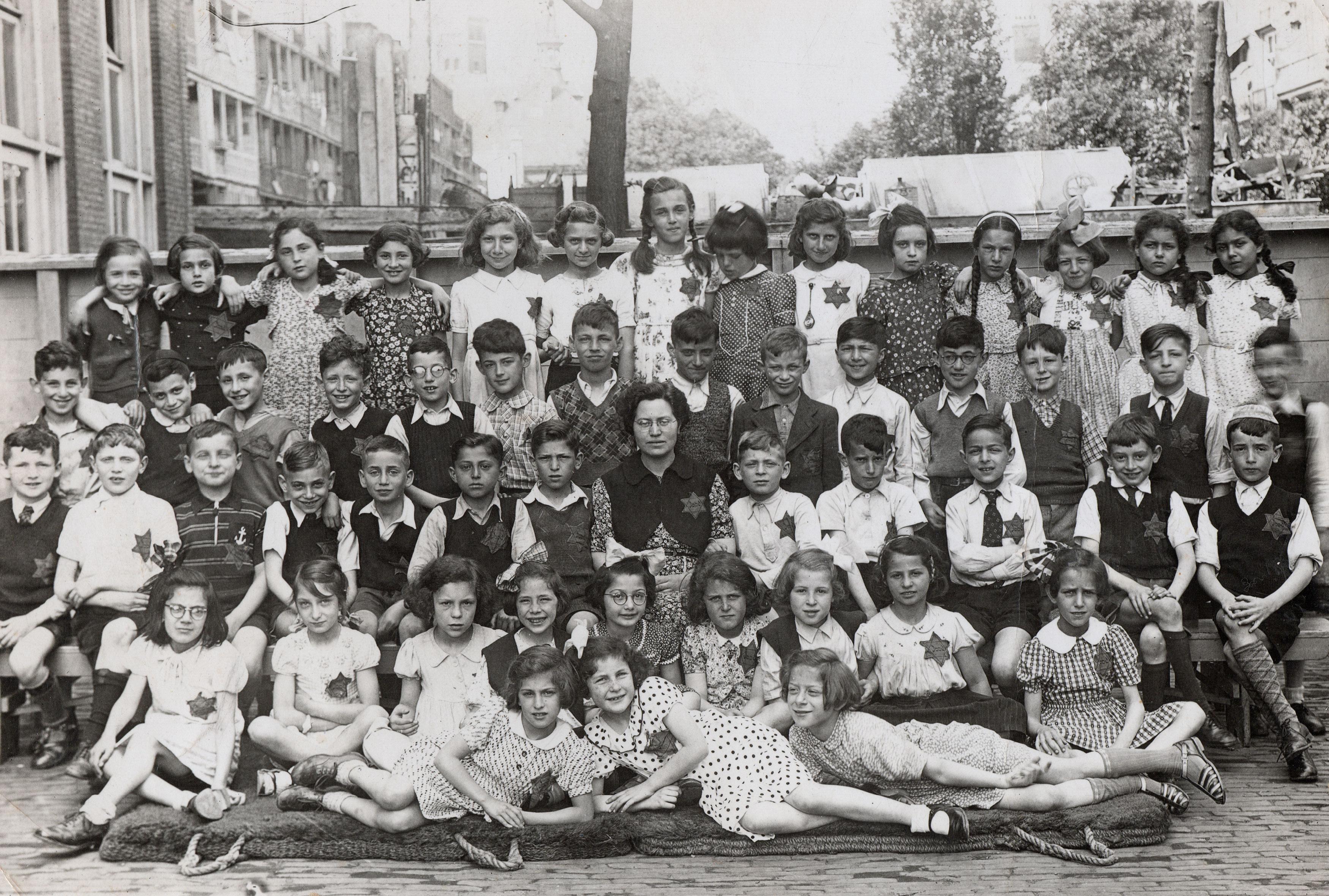
© Private property of the Tal family
The photograph shows fifty-two children in Ruth and No’omi’s class and the teacher Henriette Van Pels wearing the yellow patch at Herman Elte School. No’omi (right) and Ruth are standing in the top row on the far right.
The teacher was arrested in June 1943, deported to Sobibor and murdered on 9 July 1943. The list of names of this class has been lost, and the fates of all the pupils are not known.
“A few days before the day we were all required to wear a ‘yellow star’, our mother brought a sheet of cloth on which Stars of David were printed.” Weiter
Every patch had to be cut out along a dashed line that surrounded it.
Ruth and I, who loved doing handicrafts, sat around the table with our mother and grandma, and we meticulously cut star after star along the marked line. Mother and Grandma sewed them on all our clothes.
The next day, 3 May 1942, we left the house with the stars sewn on our clothes. Father said we have nothing to be ashamed of; we have something to be proud of! It wasn’t exactly a jewel on our nice summer dresses, but I don’t remember being ashamed. It must have helped us to be together and with other “star kids” who accompanied us on the way to school.
How did the German occupiers begin expropriating Jewish business owners?
As early as autumn 1940, the German occupiers ordered Jewish owners to register their businesses. From spring 1941 onwards, these businesses were dissolved or placed under the supervision of an administrator and expropriated.
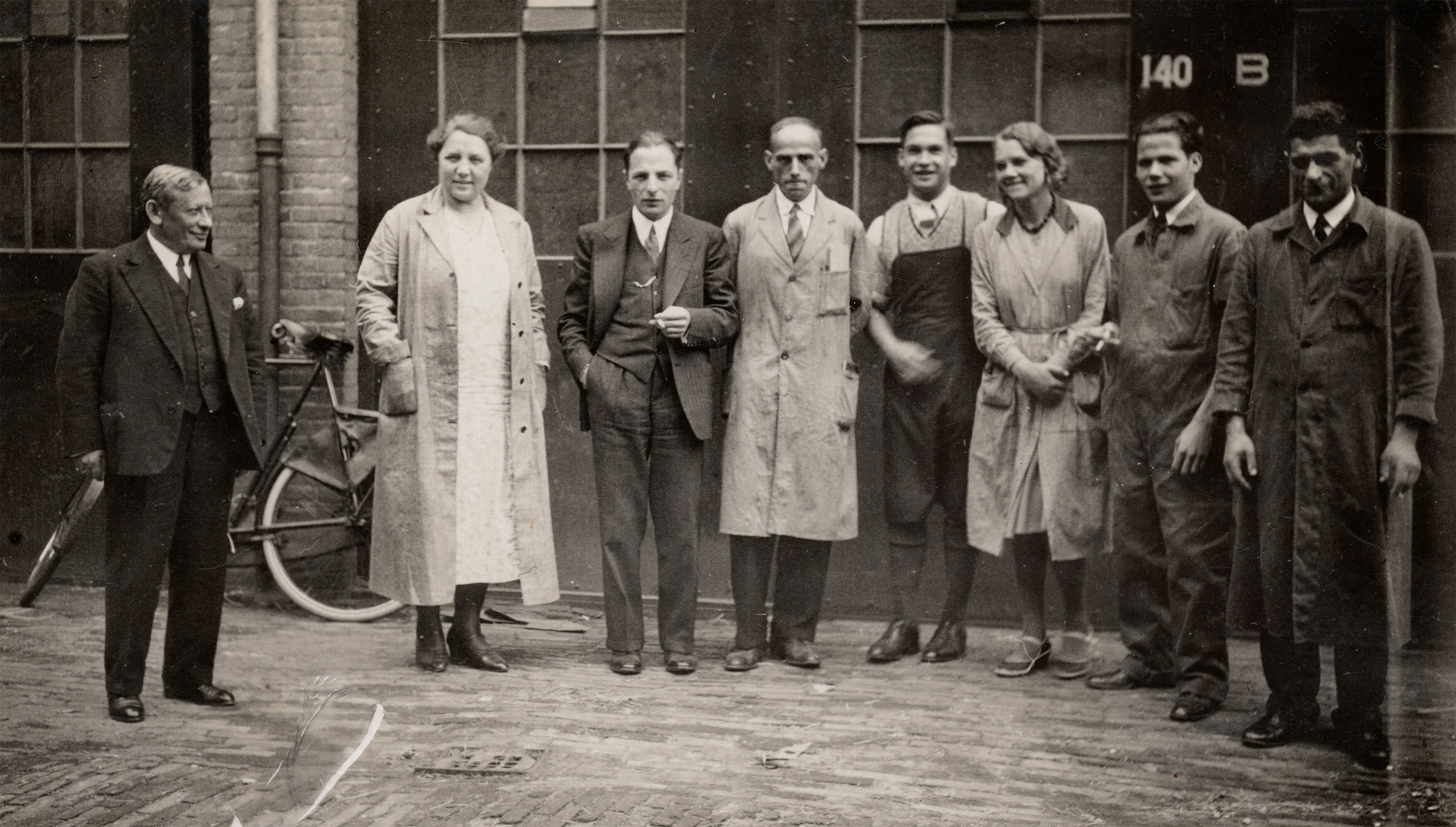
© Private property of the Rinat family
“Father was required to hand over the business by September 1942.” Weiter
He transferred it to Herzog, a German leather expert who became the factory manager overnight. The situation got worse, the summer vacation came, and we could feel the tension in the air.
One day I went with Father to the factory and saw him go to open mail, and the German manager forcefully stopped him as he put his hand on the pile of letters and said, “Mr. Reiner, from now on I am the boss here.” He said it in Dutch, in a language devoid of etiquette or emotion. Father got the message. He did not reveal to me the pain he must have felt having to hand over to foreign hands the “Rynco” factory that he had painstakingly built and that was named after him. It was no longer his.
What did expropriation mean for the Jews who lost their businesses?
The expropriated Jewish owners lost not only their companies, but also their jobs and income. This was dangerous because, as of March 1942, anyone unemployed risked being sent to a labour camp in the Netherlands.
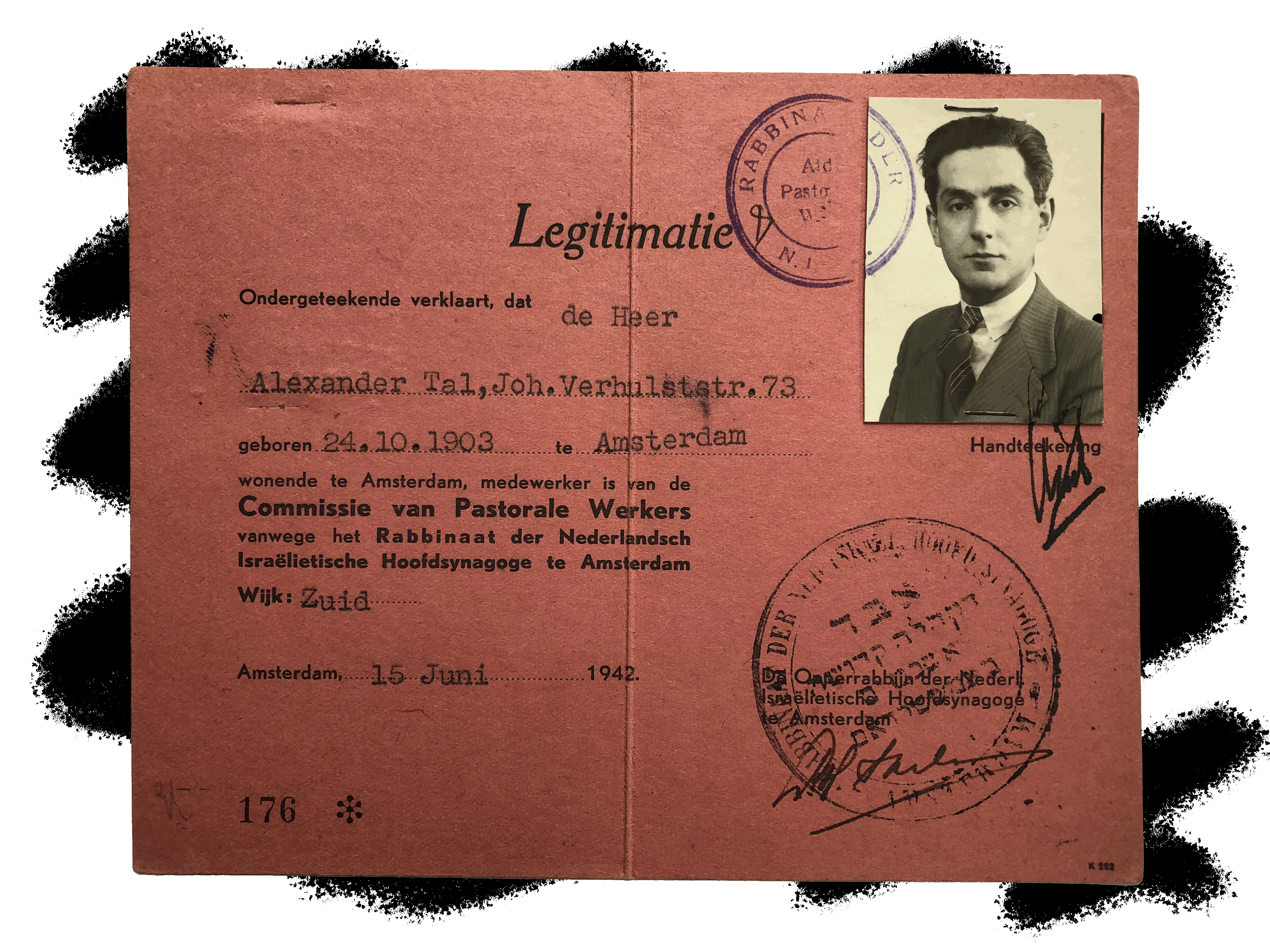
© Private property of the Tal family
Transcription
The undersigned declares that Mr
Alexander Tal, Joh[annes] Verhulststr[aat] 73,
born on 24 October 1903 in Amsterdam
residing in Amsterdam, is an employee of the Committee of Pastoral Workers working for the Rabbinate of the Dutch Israelite Main Synagogue in Amsterdam
District: South
Amsterdam, 15 June 1942
“Father was left without employment. Friends and acquaintances arranged a position for him as an official employee of the Rabbinate.” Weiter
In September, he was moved to a different job working for the Jewish Council.
He worked as a metalwork teacher at a vocational training school – Jewish, of course – a job that suited him much better.
What happened to the Jewish people’s private property?
All Jews had to hand over their valuables and transfer their assets to a bank controlled by the German occupiers. Some people managed to hide some of their possessions with the help of neighbours or acquaintances.
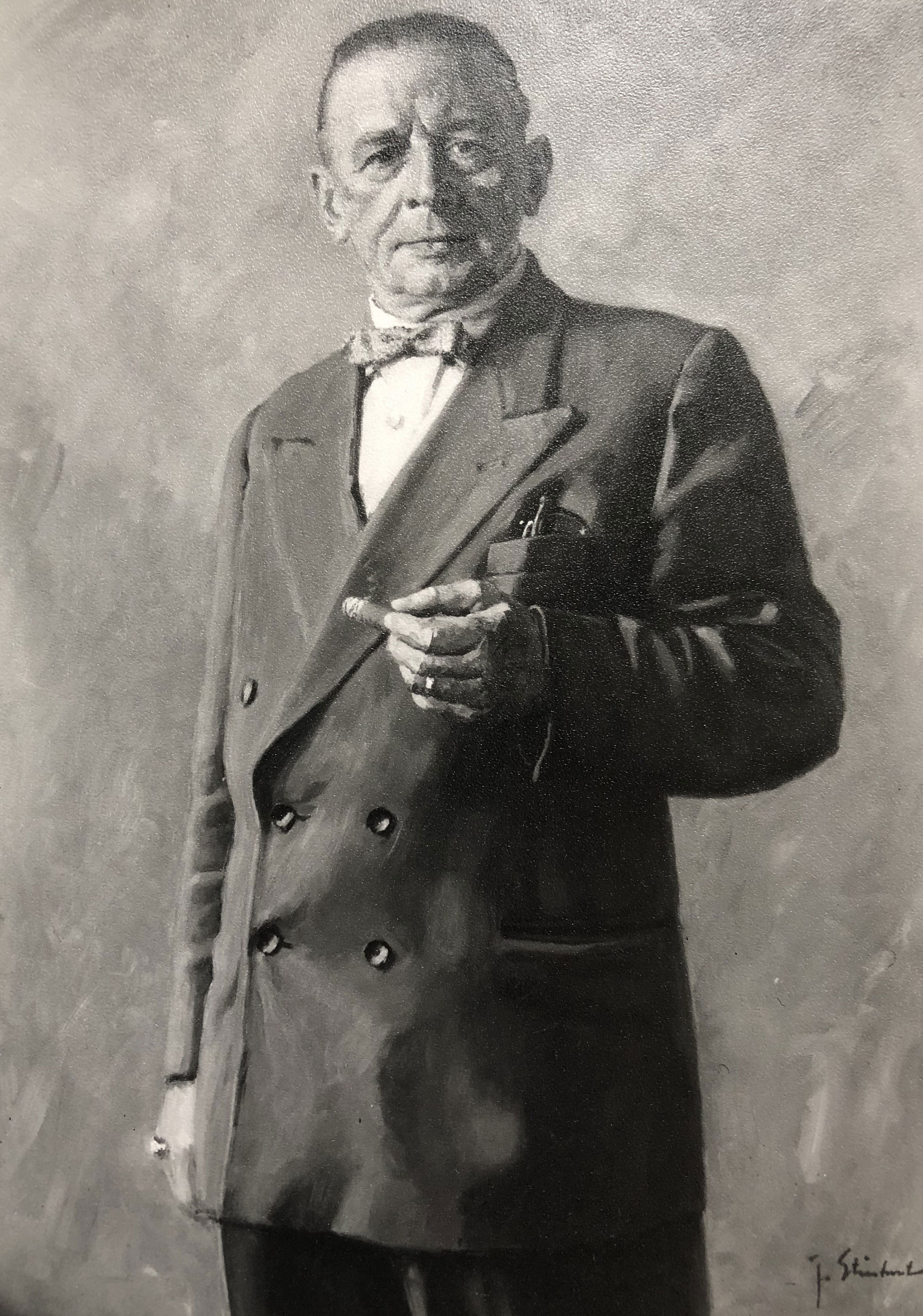
“Leo Hillen was our neighbour in Johannes Verhulststraat. A devout Catholic, and one of the most important contractors in the Netherlands, he and Father developed a great friendship.” Weiter
Father spent quite a bit of time with his friend, usually in the neighbour’s house, even though the Nazis forbade Jews from visiting the home of a non-Jew.
In May 1942, when the Germans published a decree demanding that Jews hand over their valuables, such as jewellery, silverware, carpets, pictures, etc., Leo Hillen hid ours for us in his house. We also gave him books and photo albums.
After the war, we got it all back. This is why we still have the old pictures that accompany this project.
Why did Marion Amster join the Tal family?
Fré Tal, the mother of Chanan, Ruth and No’omi, worked for the Jewish Council at the Department for Assistance for Non-Dutch Jews. There she learned that a Jewish girl who had fled from Germany to the Netherlands urgently needed accommodation. This girl was Marion Amster.
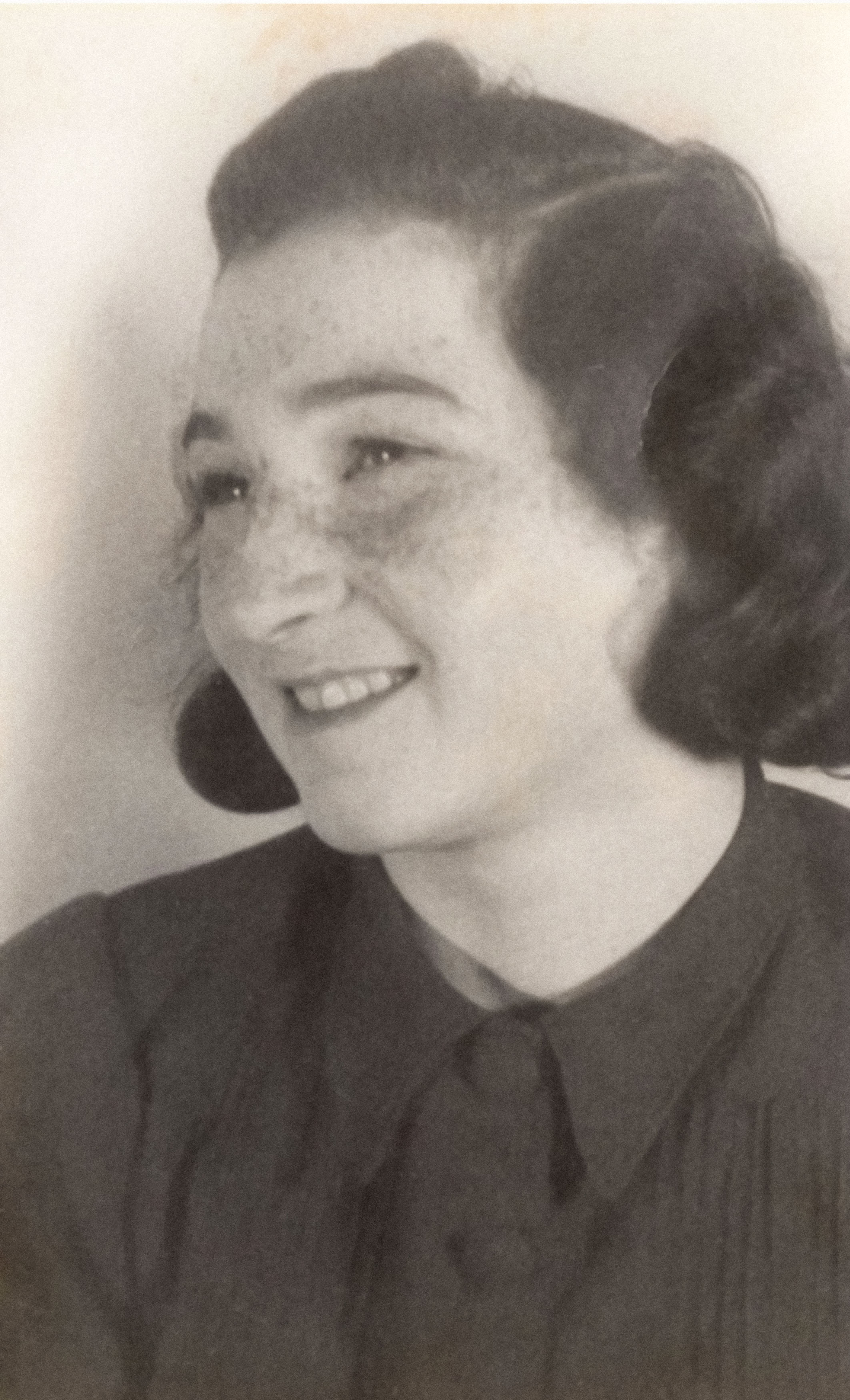
© Private property of the Klugerman family
“On Friday, 14 August 1942, we welcomed Marion Amster into our family.” Weiter
Marion was born in Germany on 9 April 1928. In early 1939, Marion and her younger sister, Ruth, arrived in the Netherlands on two separate Kindertransports. After a few days in quarantine, they arrived at the “Burgerweeshuis”, an orphanage housing several Jewish children.
Ruth, Marion’s sister, left on 14 May 1940 as part of the last Kindertransport from IJmuiden, Netherlands, and spent the war in Wales.
In the summer of 1939, Marion moved into foster care.
Three years later, on a Friday, her foster parents went into hiding with their children and did not take Marion with them. When she got home from school, she found an empty house. A note and a bar of chocolate were placed on the kitchen table. The note said she had to contact her guardian at the Jewish Council’s “Department for Assistance to Non-Dutch Jews”. The guardian was single and couldn’t accommodate a 14-year-old girl in her rented room on the Shabbat. She called my mother and asked if she could take in Marion for the weekend.
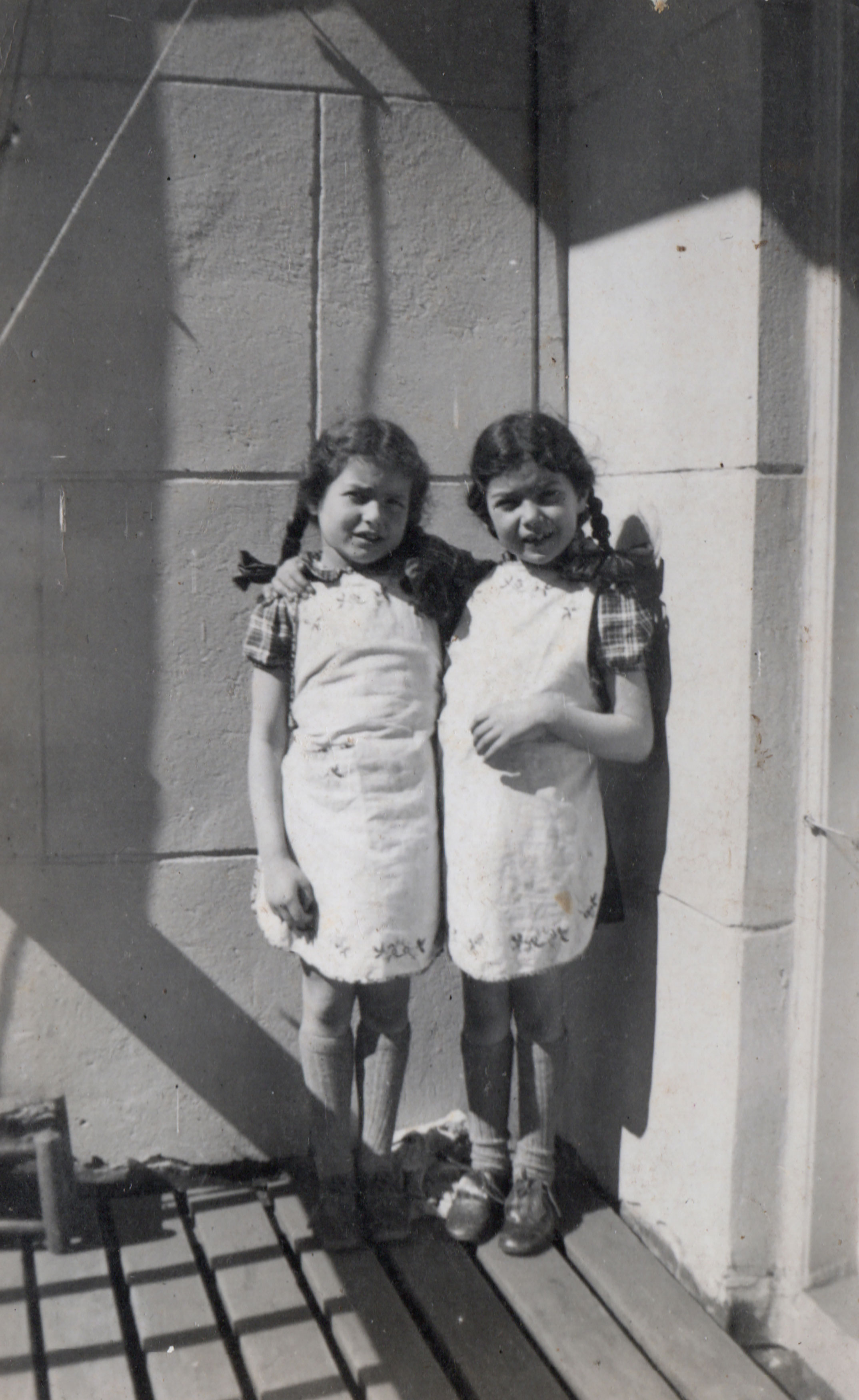
© Private property of the Tal family
“Ruth and I went out to wait for Marion on the balcony in front of the house. We knew her from school, and we knew she had beautiful chestnut hair and that she was very good at gymnastics!” Weiter
We stood there, excited, looking out.
There she is! Down the street, walking next to someone from the Jewish Council. She was invited to stay with our family for Saturday about an hour earlier at the Jewish Council. She had no idea what kind of family she was going to! Scary!
However, it is clear that she accepted the invitation, which for her meant rescue. Where else would she have gone after the Cohen family, her foster family, disappeared?
“On Saturday night, our parents asked us if it was okay for Marion to stay with us. We agreed without hesitation. Marion went through the war with us.”